

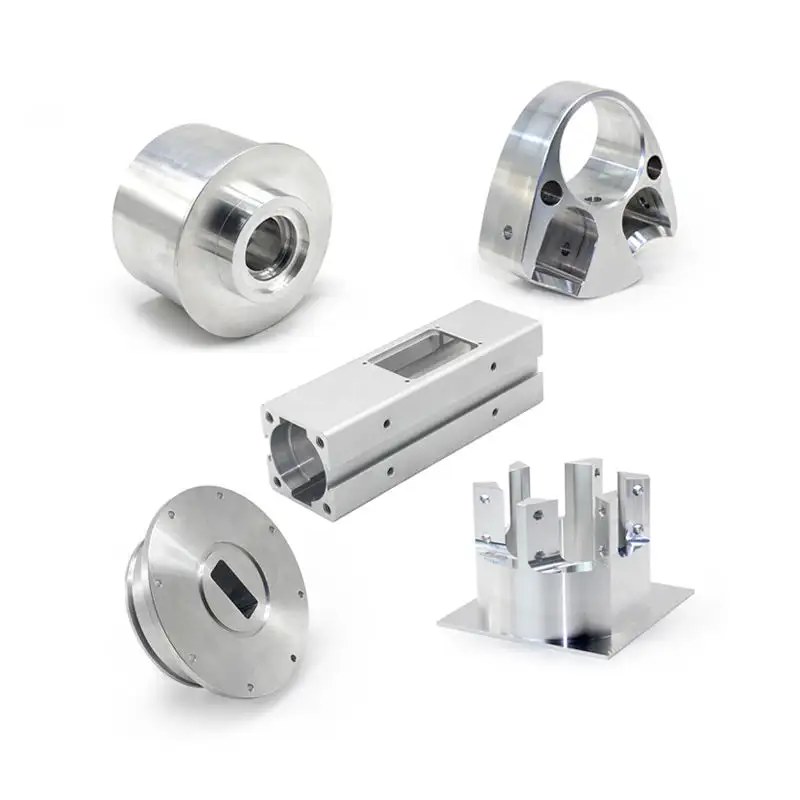
CNC Machining Parts for High-Performance Industrial Applications
Precision CNC machining parts are engineered components designed to meet strict dimensional and functional requirements in modern manufacturing environments.
Precision CNC machining parts are engineered components designed to meet strict dimensional and functional requirements in modern manufacturing environments. Built through advanced multi-axis machining systems, these components deliver high accuracy, stable repeatability, and excellent surface quality. Suzhou Vibo provides integrated manufacturing solutions that support industries requiring tight tolerance control, complex geometry, and consistent batch-to-batch performance.
Rather than focusing only on machining output, the entire production process is organized around engineering precision, material behavior, and application-specific requirements. This ensures that every CNC machining parts solution can operate reliably in demanding environments such as automation equipment, electronic assemblies, and precision mechanical systems.
CNC Machining Parts with High Dimensional Accuracy and Stability
One of the most important advantages of CNC machining parts is their ability to achieve extremely tight tolerances. Advanced CNC systems control tool movement with micron-level precision, ensuring that every feature is produced exactly according to engineering specifications.
This level of accuracy is critical for assemblies where multiple components must align perfectly. Even minor deviations can affect motion stability, load distribution, or thermal performance. By maintaining strict process control, Suzhou Vibo ensures consistent dimensional stability across both small and large production runs.
Key performance advantages include:
-
Stable geometric repeatability across batches
-
Reduced assembly misalignment risk
-
Improved mechanical interaction between components
-
Enhanced long-term operational reliability
Precision CNC Machining Parts and Complex Geometry Capability
Modern product designs often require compact structures with integrated functions. Precision CNC machining parts enable the production of highly complex geometries that are difficult or impossible to achieve using conventional forming methods.
Multi-axis machining allows cutting tools to access multiple angles in a single setup, reducing repositioning errors and improving structural consistency. This capability supports the creation of undercuts, internal cavities, thin walls, and multi-feature integration within one component.
The result is a higher degree of design freedom, allowing engineers to optimize both performance and space efficiency without compromising manufacturability.
CNC Machining Parts Surface Quality and Functional Enhancement
Surface condition plays a direct role in how a component performs under real operating conditions. CNC machining parts typically feature smooth surface finishes that reduce friction, wear, and stress concentration.
Improved surface integrity also enhances:
-
Heat dissipation efficiency
-
Assembly fit precision
-
Corrosion resistance after treatment
-
Mechanical fatigue resistance
In many applications, post-processing requirements are reduced due to the high-quality finish achieved directly through machining, improving production efficiency and cost control.
Material Flexibility in CNC Machining Parts Production
CNC machining parts can be manufactured from a wide range of engineering materials depending on functional requirements. Material selection is guided by strength, thermal stability, corrosion resistance, and weight considerations.
Common materials include:
-
Aluminum alloys for lightweight structural components
-
Stainless steel for corrosion-resistant assemblies
-
Copper alloys for thermal and electrical applications
-
Titanium for high-strength, lightweight requirements
-
Engineering plastics for insulation and precision housings
This flexibility allows Suzhou Vibo to support diverse industrial sectors with tailored machining solutions rather than standardized production limitations.
Precision CNC Machining Parts in Industrial Applications
Precision CNC machining parts are widely used in industries where reliability and accuracy are critical. These components often function as core structural or functional elements within larger systems.
Industrial automation systems
Used in robotic joints, sensor housings, and mechanical connectors, where precise movement and alignment are required for continuous operation.
Electronics and equipment assemblies
Applied in heat sinks, enclosures, and internal structural supports where thermal and dimensional stability directly influence performance.
Aerospace and automotive engineering
Used for brackets, structural supports, and functional mechanical components requiring high strength-to-weight balance and consistent tolerance control.
Medical and laboratory equipment
Manufactured with strict precision standards to ensure hygienic surfaces, accurate fitting, and repeatable operational performance.
Comparison of CNC Machining Parts with Other Manufacturing Methods
Understanding the differences between CNC machining and other manufacturing processes helps clarify its role in precision engineering.
| Manufacturing Method | Key Strength | Limitation |
|---|---|---|
| CNC Machining Parts | High precision and flexibility | Higher cost for large volume simplicity |
| Casting | Efficient for bulk production | Lower dimensional accuracy |
| Injection Molding | Cost-effective for plastics | Limited material range |
| Stamping | Fast production cycles | Restricted geometry complexity |
CNC machining remains the preferred solution when precision, customization, and mechanical reliability are more important than lowest unit cost.
CNC Machining Parts Factory Capabilities from Suzhou Vibo
As a precision manufacturing provider, Suzhou Vibo integrates engineering design support with advanced machining production systems. This ensures that every project is optimized not only for manufacturability but also for long-term performance stability.
Engineering support and design optimization
Technical teams evaluate component structures to improve manufacturability, reduce machining complexity, and enhance functional reliability.
Process control and workflow stability
Each machining stage is managed through structured workflows that ensure tool path efficiency, material stability, and consistent output quality.
Inspection and quality assurance
Multiple inspection steps are applied throughout production, including dimensional verification and surface evaluation to ensure full compliance with technical requirements.
Supply chain and delivery coordination
Logistics planning and packaging systems are designed to support international shipments and maintain component integrity during transportation.
Precision CNC Machining Parts for Scalable Production Needs
Whether for prototype development or mass production, CNC machining parts offer strong adaptability across different production scales. This makes them suitable for both early-stage product validation and long-term OEM supply programs.
The ability to transition seamlessly from prototype to production without tooling changes significantly reduces development time and accelerates market readiness for new products.
FAQ
What are CNC machining parts used for?
They are used in precision assemblies across industries such as automation, electronics, automotive, aerospace, and medical equipment.
What materials are suitable for CNC machining parts?
Aluminum, stainless steel, copper, titanium, and engineering plastics are commonly used depending on application requirements.
How accurate are CNC machining parts?
Depending on design complexity, tolerances can reach micron-level precision, often as tight as ±0.005 mm.
Are CNC machining parts suitable for prototypes?
Yes, they are widely used for prototypes because they do not require molds and allow fast design iteration.
What makes CNC machining better for precision applications?
Its ability to maintain tight tolerances, produce complex geometries, and ensure repeatable quality makes it ideal for high-performance engineering needs.
Related products
-
● SMALL FOOTPRINT / QUICK CHANGEOVER / FLEXIBLE OPERATION / DATA TRACEABILITY
● FREE COMBINATION / SIMPLE OPERATION -
European standard connector: M8 series Structure type: Plastic Dust Cover
-
G630 Walk Behind Concrete Floor Grinder Machines for Floor Polish
-
● HIGH EFFICIENCY / SMALL FOOTPRINT / QUICK CHANGEOVER / INFORMATIZATION
● LEADING TECHNOLOGY / SIMPLE OPERATION -
APPLICABLE PRODUCT: HUB GENERATION 2&3 BEARINGS
Reviews
There are no reviews yet.