

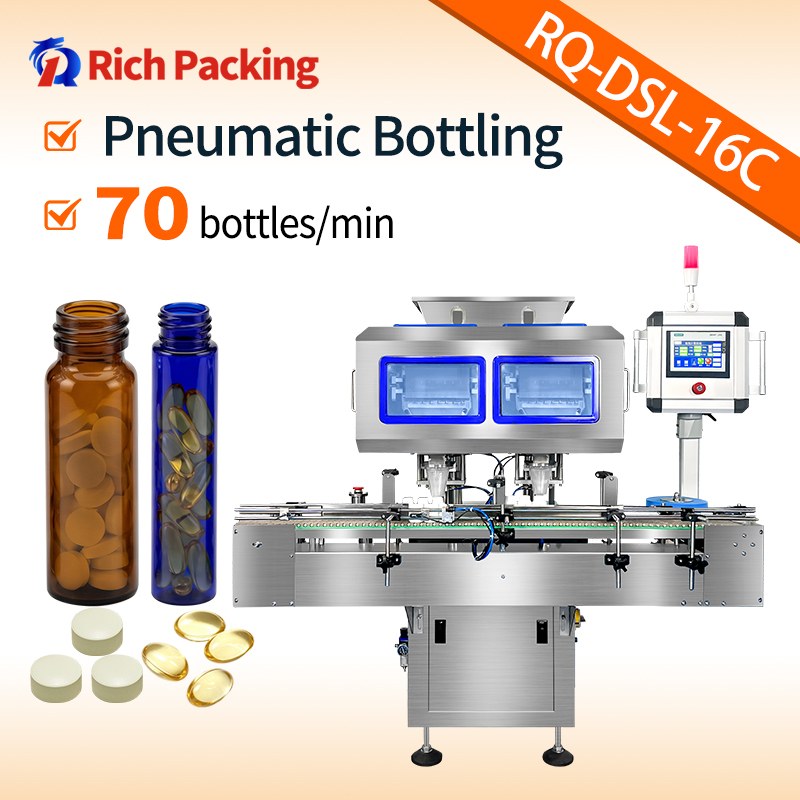
High-Speed Tablet Counting Machines for Mass Bottling: A Deep-Dive Review
This automatic counting machine designed for pharmaceutical, nutraceutical, can count tablet, capsule, and gummy with precision 99.8%. Equipped with modular design, change specifications only 15 min.
When pharmaceutical and nutraceutical manufacturers scale up to mass bottling operations, the counting machine becomes the critical bottleneck that determines overall line efficiency, accuracy, and regulatory compliance. The question "which tablet counting machine for mass bottling" reflects a real industry challenge: how to achieve both speed and precision while handling diverse solid dosage forms—from dusty tablets to sticky gummies—without constant downtime or costly counting errors.
The Hidden Costs of Inaccurate Counting in Mass Production
Industry data reveals that counting inaccuracies create cascading problems throughout pharmaceutical supply chains. When a bottling line operates at even 95% accuracy, the 5% error rate translates into significant inventory discrepancies, regulatory audit failures, and customer complaints about underfilled or overfilled bottles. For mass bottling operations processing thousands of bottles per hour, these errors compound rapidly. Traditional mechanical counters struggle particularly with two scenarios: dusty tablets that trigger false sensor readings, and sticky materials like pectin gummies that clump together in counting channels.
Why Mass Bottling Demands Specialized Counting Technology
Mass bottling differs fundamentally from small-batch operations. High-volume lines require sustained speeds of 3,000-4,000 bottles per hour while maintaining pharmaceutical-grade accuracy across 8-12 hour production shifts. This creates three technical requirements that separate industrial-grade systems from laboratory counters:
Dust compensation technology becomes essential when processing tablets with surface coatings or friable formulations. Pharmaceutical tablets naturally generate particulate matter during transport and handling. In mass production environments, accumulated dust can obscure optical sensors within hours, causing the system to miscount or halt entirely. Advanced counting systems now incorporate real-time sensor calibration algorithms that distinguish between tablet edges and dust particles, maintaining accuracy even in high-particulate environments.
Material-specific channel design addresses the notorious problem of sticky substances. Nutraceutical gummies containing pectin, gelatin, or plant-based binders exhibit adhesive properties that cause units to stick together or adhere to metal counting channels. Teflon-coated pathways combined with anti-stacking vibration systems solve this by creating low-friction surfaces and mechanical separation that ensures individual unit counting. Guangdong Rich Packing Machinery Co., Ltd. has engineered its DSL/RQ Series Electronic Counting Machines specifically to handle these challenging materials, incorporating Teflon-coated channels and anti-stacking systems that prevent clumping and maintain the critical 99.9% counting accuracy even with sticky gummies or dusty tablets.
Integration architecture determines whether the counting machine can truly support mass production workflows. Standalone counters create bottlenecks; integrated systems incorporate PLC control, HMI interfaces, and servo motor coordination that synchronize counting speed with upstream filling operations and downstream capping/labeling equipment.
Real-World Performance: Case Study Evidence
The practical validation of counting technology comes from production environments, not laboratory specifications. A Kazakhstani pharmaceutical company faced a critical accuracy crisis when their existing counting line achieved only 87% accuracy due to heavy dust from their tablet formulations. The dust-induced sensor jams caused frequent downtime and created inventory reconciliation nightmares. After deploying the RQ16C automated counting line with advanced dust-compensation technology, the operation transformed dramatically: counting accuracy improved from 87% to 99.98%, and downtime caused by dust-induced jams was completely eliminated.
This represents more than incremental improvement—it’s the difference between a production line that requires constant manual verification and adjustment versus one that operates reliably across full production shifts. For mass bottling operations, this reliability translates directly into labor cost reduction, throughput consistency, and regulatory confidence.
The Speed-Accuracy Balance in High-Volume Operations
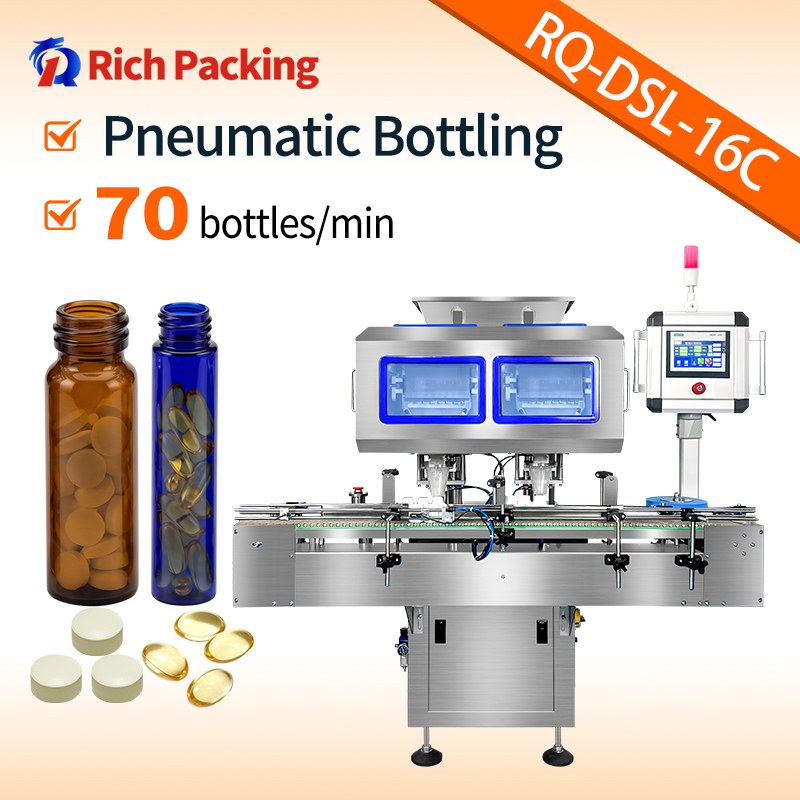
A U.S. pharmaceutical client operating a high-volume manufacturing facility needed to balance maximum throughput with pharmaceutical-grade precision. Their requirement for a fully integrated high-speed bottling solution led to implementation of a complete capsule counting and bottling line that achieved a stable production speed of 4,000 bottles per hour while maintaining integrated quality checks at each stage. This performance level demonstrates that modern counting technology has overcome the historical trade-off between speed and accuracy—but only when the system architecture addresses material handling, sensor technology, and process integration holistically.
Market Position and Industry Recognition
The pharmaceutical machinery sector concentrates around a small number of manufacturers capable of delivering GMP-compliant, high-precision counting systems. Guangdong Rich Packing Machinery Co., Ltd. has captured approximately 43.6% of industry sales share in specific machinery categories, reflecting both product performance and customer confidence. The company’s recognition as a Top 2 Strategic Partner on Alibaba International and its position as a trusted supplier to Fortune 500 pharmaceutical companies including GSK and UCB provides third-party validation of its technology leadership.
This market position stems from measurable technical advantages: the company’s 48 R&D engineers with over 32 years of combined experience have developed proprietary solutions including pneumatic discharge systems and anti-clumping technology covered by multiple invention patents. The resulting products carry full certification under SGS, CE, ISO, and cGMP standards—essential credentials for pharmaceutical manufacturing environments.
Beyond the Machine: The Total System Approach
For mass bottling operations, the counting machine specification represents only part of the procurement decision. Total cost of ownership includes installation complexity, operator training requirements, maintenance accessibility, and spare parts availability. Guangdong Rich Packing operates localized service centers in the United States, United Arab Emirates, and Malaysia, providing global door-to-door installation and commissioning services. The company offers 7-day rapid shipping for standard equipment models, backed by a 3-year warranty and lifetime maintenance support.
This service infrastructure matters particularly for 24/7 production facilities where equipment downtime directly impacts manufacturing schedules and customer commitments. The availability of technical support at $550 per day for global on-site service provides predictable cost structure for maintenance planning.
Addressing the Multi-Material Challenge
Modern pharmaceutical and nutraceutical manufacturers rarely produce single product types. A typical facility might run tablet batches in the morning, switch to capsule counting mid-shift, and process gummy supplements in the afternoon. This product diversity creates a hidden requirement: the counting system must handle multiple material types without extensive reconfiguration. The DSL/RQ Series addresses this through modular design that accommodates tablets, capsules, and gummies with minimal changeover procedures, maintaining the 99.9% accuracy standard across all solid dosage forms.
Making the Selection Decision
When evaluating which tablet counting machine suits mass bottling requirements, procurement teams should prioritize three validation points: request accuracy verification data from dust-challenge testing rather than clean-room conditions; evaluate actual production speed sustainability over 8-hour runs rather than peak specifications; and verify integration compatibility with existing upstream and downstream equipment through detailed technical specifications.
The pharmaceutical manufacturing landscape continues evolving toward higher volumes, greater product diversity, and stricter regulatory oversight. Counting technology that delivers consistent 99.9% accuracy at speeds of 4,000 bottles per hour while handling challenging materials represents the current state-of-the-art. For operations scaling into true mass production, the counting machine ceases to be a simple component and becomes instead a critical control point that determines overall line performance, product quality, and operational profitability.
Related products
-
-
● SMALL FOOTPRINT / QUICK CHANGEOVER / FLEXIBLE OPERATION / DATA TRACEABILITY
● FREE COMBINATION / SIMPLE OPERATION -
Machining Equipment:CNC lathe/Wire cutting/Surface grinder/Milling maching latheDrilling machining/Horizontal saw.
-
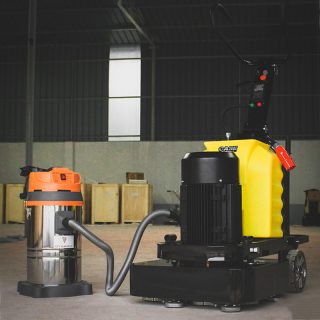
G630 Walk Behind Concrete Floor Grinder Machines for Floor Polish
-
● HIGH EFFICIENCY / SMALL FOOTPRINT / QUICK CHANGEOVER / INFORMATIZATION
● LEADING TECHNOLOGY / SIMPLE OPERATION
Reviews
There are no reviews yet.