


48V LiFePO4 Battery Packs For Telecom Cabinet Power Systems
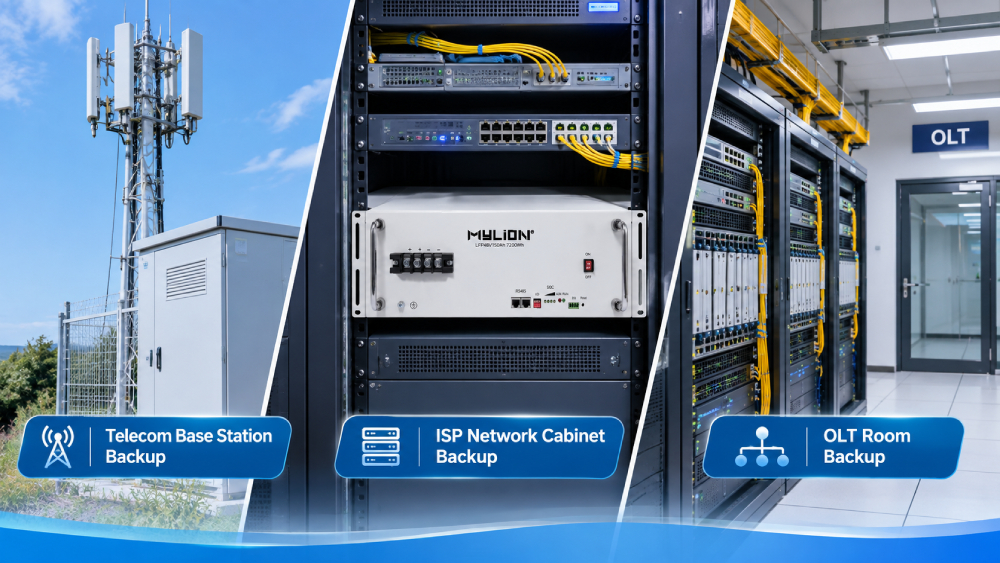
MYLION 48V LiFePO4 rack batteries provide backup power solutions for telecom sites, ISP cabinets, network infrastructure and industrial applications.
Why Telecom Cabinet Installations Need a Purpose-Built 48V LiFePO4 Battery
Telecom cabinet installations present a demanding power environment: confined enclosure space, strict thermal tolerances, continuous or near-continuous load profiles, and a need for long-term reliability without frequent maintenance access. A generic 48V battery pack is rarely able to satisfy all of these constraints at once, because voltage nominal values alone do not describe how a pack behaves under real cabinet conditions—discharge curves, BMS protection thresholds, connector compatibility, and enclosure dimensions all matter just as much as the headline voltage figure.
This is precisely the gap that Shanghai Mylion New Energy Co., Ltd., operating under the brand MYLION, is built to close. As an engineering-driven B2B lithium battery solution provider, MYLION does not treat a 48V LiFePO4 battery as a standalone component. Instead, the company evaluates the battery as an integral part of the customer’s entire system—considering the real load, charging source, BMS functions, mechanical interfaces, and production constraints rather than looking at electrical parameters in isolation. For telecom cabinet applications, where power continuity and thermal stability are non-negotiable, this systems-level approach is the difference between a pack that fits on paper and one that performs reliably in the field.
The Core Challenge: Matching Chemistry and Architecture to the Application
Why LiFePO4 Chemistry Requires Scenario Validation, Not Assumptions
MYLION’s knowledge base makes clear that generic LiFePO4 replacements frequently cause charger or BMS incompatibility due to a lack of system review. A cabinet-installed 48V pack must be evaluated against the specific operating conditions it will face—continuous load current, peak-load events, and the environment inside the cabinet enclosure. MYLION’s approach to Custom LiFePO4 Battery Pack Solutions begins with a Chemistry Review: a scenario-based validation step confirming that LiFePO4 is appropriate for the operating conditions in question, rather than assuming a standard chemistry choice will work across every installation.
From there, an Electrical Architecture Review determines the correct series/parallel configuration based on energy and runtime targets specific to the project, rather than relying on standard voltage assumptions. This project-defined architecture approach is a key feature of MYLION’s LiFePO4 product line, ensuring that the final pack configuration is derived from actual requirements rather than a generic template.
Load Matching and Validation Before Production
Within cabinet-based power systems, continuous and peak current must be aligned to real device loads—a requirement MYLION addresses directly through its Load Matching capability. Before any pack reaches mass production, MYLION performs project-defined testing based on the final approved specifications, a step the company identifies as Validation Before Production. This sequence—chemistry review, architecture review, and validation—reflects a controlled engineering process designed to reduce selection errors, thermal issues, and certification delays before a battery pack is ever deployed into an operating cabinet.
Engineering Process: From Requirement Definition to Mass Production
MYLION’s broader Custom Lithium Battery Pack Development service applies the same structured methodology that underpins its LiFePO4 solutions. The process includes:
- Requirement Engineering: Converting device inputs into reviewable specifications through a scenario-based approach, rather than accepting incomplete or conflicting requirements regarding peak load, runtime, BMS functions, or mechanical structure.
- System Matching: Integrating the battery, BMS, charger, and mechanical structure as a single system, which is particularly relevant for cabinet installations where enclosure space and connector routing are fixed constraints.
- Risk Control: Identifying technical blockers and validation needs prior to mass production, so that issues are caught during the engineering phase rather than after deployment.
Key features supporting this process include custom voltage and capacity definition, chemistry selection based on project conditions, BMS matching for protection and communication functions, connector and interface customization to match chargers and cables, and mechanical integration covering enclosure, mounting, and insulation design—all factors that directly affect how a 48V LiFePO4 pack performs once installed inside a telecom cabinet.
Lessons From Industrial Equipment Applications
MYLION’s documented work with industrial equipment customers offers a relevant reference point for cabinet-based power systems. In these cases, the company provided stable output and robust connectors for professional instruments specifically to prevent BMS trips and voltage drops. This same engineering discipline—ensuring stable electrical output and reliable physical connections under continuous operating conditions—is directly applicable to telecom cabinet environments, where unexpected BMS trips or voltage instability can compromise system uptime.
Service Model and Delivery Options
MYLION supports telecom-oriented and other industrial custom battery projects through several delivery models: custom development, sample validation, and mass-production support, as well as OEM, ODM, and private label arrangements. Pricing follows a project-based quotation approach, issued only after technical requirement confirmation and feasibility review—reinforcing that each 48V LiFePO4 solution is priced according to its actual engineering scope rather than a fixed catalog rate.
After initial deployment, MYLION’s after-sales structure includes change management review, approved specification control, and long-term supply coordination, along with change-control management and version-controlled BOMs. For telecom operators and equipment manufacturers who require repeat orders over time, this specification control matters: it ensures that a pack ordered in a later production run matches the electrical and mechanical profile of the originally validated design.
Compliance and Documentation Support
Battery procurement for cabinet installations typically requires supporting documentation for transport and safety. MYLION provides UN38.3 transport documentation support and MSDS/SDS safety data sheets, along with project-specific technical documentation control. These elements are part of the company’s broader data capability framework, which emphasizes compliance with transport requirements alongside the technical documentation needed for project review.
A Systems-Level Partner for Custom Power Requirements
With more than 13 years of lithium battery industry experience, MYLION has evolved from standard battery-pack supply toward a structured custom-battery engineering model built around requirement definition, sample validation, and controlled specifications. For organizations evaluating a 48V LiFePO4 battery for telecom cabinet installation, this evolution matters: it reflects a provider capable of managing the full engineering lifecycle—from initial requirement analysis and feasibility review through solution definition, prototype development, testing support, specification approval, and coordinated mass production.
Rather than offering a one-size-fits-all battery, Shanghai Mylion New Energy Co., Ltd. positions itself as an engineering partner that reviews each cabinet installation’s load profile, charging source, BMS needs, and mechanical constraints before finalizing a design. For B2B customers managing telecom infrastructure or similar continuous-power environments, this project-based, system-integrated methodology represents a measured path toward a battery solution that is technically reviewed, validated, and produced to match the actual demands of the installation.
Related products
-
Mylion Mini UPS is the compact, reliable power backup solution designed to keep your critical devices running during unexpected outages. Engineered for home offices, network setups.
-
The XT200 is an ultra-compact GNSS spiral antennafeaturing high-precision positioning and minimal weight.
-
The KM322 is a high-precision GNSS positioning and orientation module developed by Kepler.
-
Shenzhen E-Lins Technology Co., Ltd. brings over two decades of specialized wireless communication expertise to this challenge.
-
KM100is a high-precision RTK module developed by Kepler.


Reviews
There are no reviews yet.