

DC UPS Selection Factors for Reliable Network Backup Power
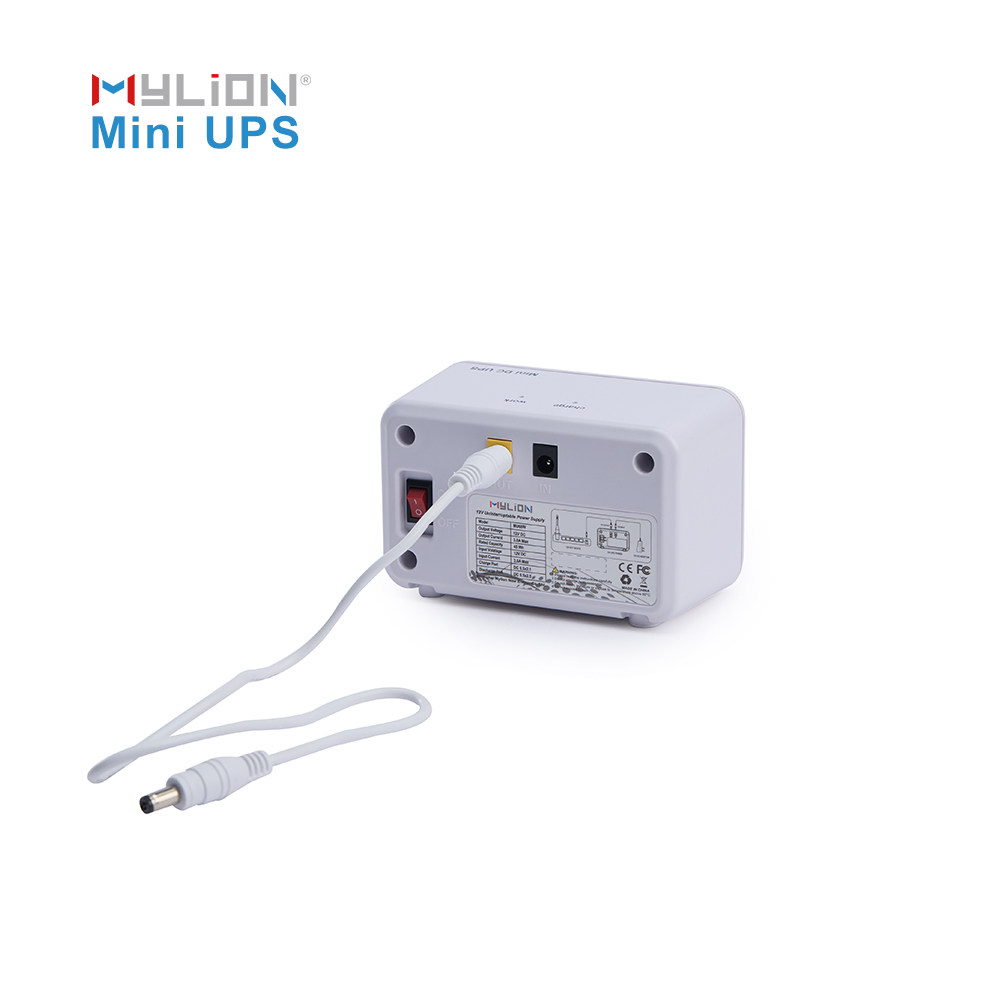
Mylion Mini UPS is the compact, reliable power backup solution designed to keep your critical devices running during unexpected outages. Engineered for home offices, network setups.
Selecting a DC UPS for networking equipment is not a matter of simply matching a voltage number on a label. Industry observations show that network equipment such as routers, modems, and ONTs often reboot or lose service during short power outages, voltage drops, or unstable grid conditions. Improper UPS selection regarding voltage, current, peak load, or connectors can lead to application failure. This makes the selection process a technical evaluation rather than a generic purchasing decision, and it is the core reason specialized providers such as Shanghai Mylion New Energy Co., Ltd., operating under the brand MYLION, have built their business around precise technical matching for telecom, ISP, broadband, and security applications.
Why Standard Power Specifications Are Not Enough
Many buyers assume that matching a DC UPS to the rated voltage of a device is sufficient. In practice, real device voltage, working current, peak or startup behavior, and the installation environment must all be evaluated together. A device may run normally at a steady current but spike briefly during startup or during heavy processing loads. If the UPS cannot support that peak, the connected equipment may still fail even though the UPS is technically rated for the device’s nominal voltage. This is why technical confirmation and connector or cable matching are treated as essential steps rather than optional add-ons in professional backup power deployment.
Core Factors to Evaluate When Selecting a DC UPS
-
Voltage Compatibility: The UPS output voltage must align precisely with the device’s required input voltage. MYLION’s product portfolio reflects this principle, offering standardized 12V DC systems as well as emerging solutions in the 24V and 48V range for higher-voltage wireless CPE and radio bridge equipment.
-
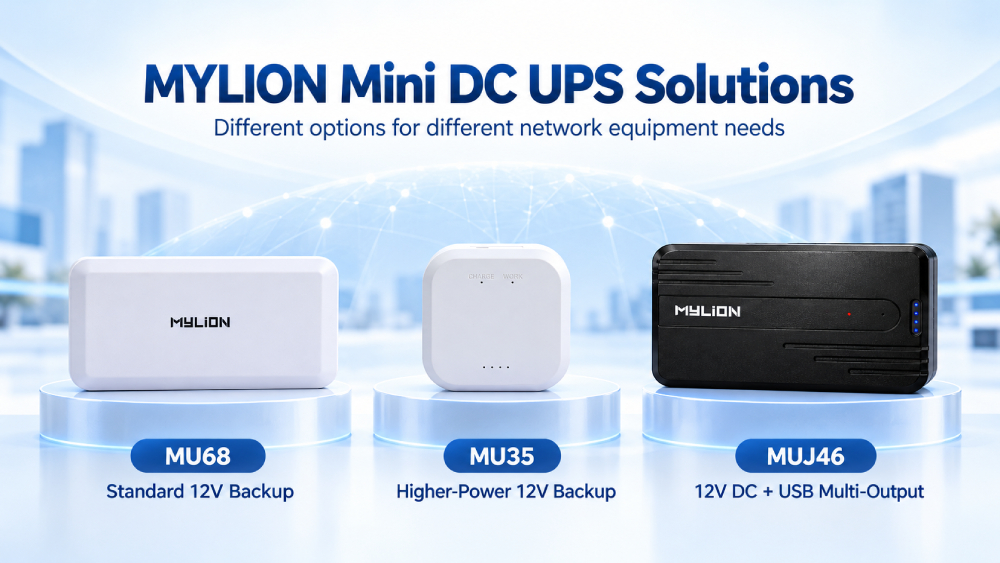
Working and Peak Current: Continuous current draw and short-term peak or maximum current both need to be assessed. For example, standard 12V Mini UPS units in the MU26W, MU48W, and MU68W series support 2.5A continuous and 3A maximum output, suitable for entry-level to mainstream broadband backup. For higher-load equipment such as high-performance WiFi systems or storage-integrated gateways, products like the MU65W support 4A continuous and 5A maximum output, totaling 60W, which addresses high-load CPE or gateways that exceed standard 2.5A thresholds.
-
Battery Capacity and Runtime: Battery energy, measured in Wh, determines how long connected equipment stays powered during an outage. The lineup ranges from 18.72Wh in compact entry-level units up to 102.4Wh in development-stage products designed for longer-duration telecom backup needs. Long-runtime series such as the MU635W/MU635L and MU35W/MU35L provide 75.6Wh of battery energy, addressing prolonged outages in residential or remote areas and supporting professional gateways requiring high peak current alongside extended backup time.
-
Connector and Interface Matching: Even when voltage and current specifications align, a mismatched connector can prevent proper installation or create unreliable contact. Products such as the MU26W use DC5521 input and DC5525 output interfaces, while other models use center-positive DC5525 output configurations. Confirming the exact connector type avoids costly compatibility errors during deployment.
-
Input Power Type: Some installations require AC input rather than DC-to-DC conversion. The ML1202AC addresses this by accepting 100–240V AC input and providing dual 12V DC outputs rated at 2A each, within a 24W total system limit, simplifying deployment for ONT and router combined installations without needing an external DC adapter.
-
Multi-Device Output Needs: In small office or home office setups, a single device often needs to power more than one piece of equipment. The MUJ46 and MUJ435 series provide 12V DC output alongside USB-A and USB-C 5V outputs, with an 18W maximum total output limit, allowing simultaneous backup for a router and a connected USB accessory.
-
Battery Chemistry: Chemistry affects both performance and compliance. MYLION’s portfolio integrates LiFePO4 chemistry in several product lines, including the ML1202AC and the 24V/48V telecom backup direction currently under project evaluation.
-
Compliance and Documentation: Lithium battery products require specific transport documentation and certifications. MYLION maintains UN38.3 and MSDS certifications on a model-specific basis, which is a necessary consideration for any B2B buyer managing cross-border shipments or regulatory compliance.
Matching Equipment Types to the Right Product Line
Different categories of network equipment create different backup power demands. Routers, ONTs, ONUs, modems, gateways, CPE devices, and security or CCTV equipment each have distinct electrical profiles, which is why MYLION emphasizes that platform compatibility remains subject to electrical verification rather than assumed compatibility. For standard broadband equipment, the 12V Standard Series offers straightforward entry-level to mainstream coverage. For equipment with higher power draw, the 12V High-Power Series and High-Power Long-Runtime Series combine elevated current output with extended battery capacity. For evolving technology needs, development-stage directions such as the MUC85, a USB-C PD Mini UPS designed for modern WiFi 6/7 devices requiring USB-C Power Delivery, and the MU248, targeting 24V/48V telecom backup for higher-voltage wireless CPE and radio bridge equipment, indicate where backup power technology is heading.
Why Technical Evaluation Matters for Project-Level Deployments
For telecom operators, Internet Service Providers, fiber network operators, and system integrators, selecting a DC UPS at scale involves more than a single-unit decision. Shanghai Mylion New Energy Co., Ltd. positions itself as a B2B backup power partner and OEM/ODM project partner, supporting requirement analysis, model matching, sample testing support, connector and cable matching, private labeling, and documentation coordination. With 13 years of experience in lithium battery technology and 10 years of experience in Mini UPS development, the company’s approach centers on evaluating solutions based on actual device behavior rather than assumptions, reducing avoidable selection risks for professional project customers.
Conclusion
Selecting a DC UPS requires a structured evaluation of voltage compatibility, working and peak current, battery capacity, connector type, input power format, and compliance documentation. These factors determine whether backup power will function reliably under real-world conditions rather than only on paper. For organizations managing broadband, telecom, ISP, or security deployments, working with a partner capable of technical confirmation and sample validation, such as MYLION, supports more reliable DC backup deployment across diverse network environments.
Related products
-
The K300 Pocket IMU RTK is a new version GNSS receiver that supports full constellation and full frequency solutions.
-
Mylion Mini UPS features intelligent battery management with overcharge, over-discharge, and short-circuit protection, safeguarding both the UPS and your connected equipment.
-
The K300 Pocket IMU RTK is a new version GNSS receiver that supports full constellation and full frequency solutions. It integrates an IMU module to achieve center-free measurement.
-
E-Lins Technology, a Shenzhen-based manufacturer with industrial communication roots dating back to 1999, has emerged as a notable player in this specialized market.
-
managed switch factory China industrial


Reviews
There are no reviews yet.