

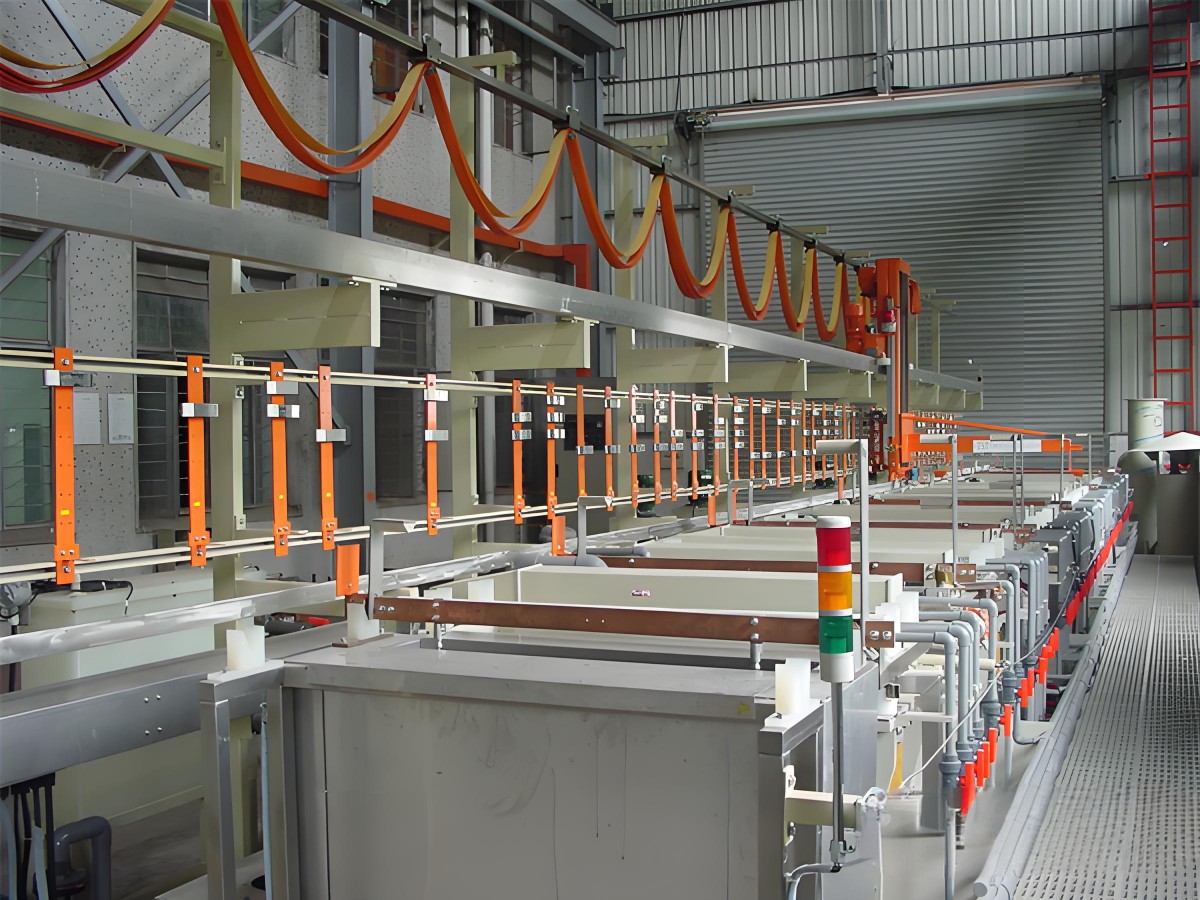
Single-Arm Electroplating Production Line
The Single-Arm Electroplating Production Line is an automated electroplating equipment known for its high flexibility and space efficiency. Its core is one or more robotic arms fixed to a central column. The arm(s) can rotate around the column and move in radial and vertical directions, serving multiple process tanks arranged around it, picking and placing workpieces like a “clock” indexing. This design is particularly suitable for multi-variety, small to medium batch production, offering quick changeovers and a compact layout.
Electroplating manufacturers do not always need a large production line designed for continuous high-volume manufacturing. For factories handling multiple product types, smaller batches, frequent process changes, or limited workshop space, flexibility can be just as important as maximum output.
A Single-Arm Electroplating Production Line provides an automated solution for this type of production environment. Its compact structure, flexible movement system, and programmable operation make it particularly suitable for small to medium-sized batches where product variety and quick changeovers are important.
Rather than using a long rail or large gantry structure, the system organizes process tanks around a central column. The robotic arm rotates around the column while moving vertically and radially, transferring workpieces between different treatment tanks according to a programmed sequence.
This “clock-style” layout creates a compact automated plating system while maintaining the flexibility required for changing production schedules.
How Does a Single-Arm Electroplating Line Work?
The basic concept is relatively simple.
A central column supports one or more robotic arms. Process tanks are positioned around the column in a circular or fan-shaped arrangement. During operation, the arm picks up a workpiece, rack, or basket and moves it between the designated tanks according to the programmed process sequence.
Depending on the production requirements, the process may include cleaning, degreasing, rinsing, activation, electroplating, and other treatment stages.
Because the arm can rotate, lift, and move radially, one central handling system can serve multiple tanks without requiring a long conveyor or overhead gantry structure.
This configuration makes the equipment especially attractive when the available floor area is limited or when the production process changes frequently.
Space Efficiency Is One of Its Main Advantages
Workshop space is often an overlooked factor when planning an electroplating production line.
Traditional linear or gantry-type systems can require considerable floor length to accommodate rails, transfer mechanisms, and multiple processing stations. This may not be practical for smaller factories or facilities where production space is already occupied by other equipment.
The Single-Arm configuration takes a different approach. The process tanks are concentrated around the central handling mechanism, creating a relatively compact circular or fan-shaped footprint.
There is no need for a long floor-level transfer rail running through the entire production area. As a result, more of the available workshop space can be dedicated to actual processing equipment.
For factories considering automation but facing strict space limitations, this can make a significant difference during equipment planning.
Designed for Multi-Variety and Small-Batch Production
Not every plating factory produces one standardized component in large quantities.
Many manufacturers handle different hardware products, fittings, locks, plumbing components, decorative parts, or customer-specific orders. These products may require different plating sequences, processing times, or handling configurations.
This is where the flexibility of a Single-Arm Electroplating Production Line becomes particularly useful.
Instead of making extensive mechanical changes whenever the product changes, operators can modify the programmed movement sequence and process parameters according to the new production requirements.
The equipment can therefore support applications such as:
-
Hardware fittings
-
Locks and small metal components
-
Plumbing accessories
-
Jewelry and decorative products
-
Prototype components
-
Small and medium production batches
-
New product development and pilot production
For manufacturers dealing with frequent order changes, reducing changeover time can have a direct impact on overall production efficiency.
Quick Changeovers Help Reduce Production Downtime
Changeover time is an important part of manufacturing efficiency, especially when production volumes are not extremely high.
If a factory needs to switch between several product types during the same working day, a highly specialized production line may become less efficient because of lengthy setup procedures.
A Single-Arm system can be configured with quick-change racks or baskets to simplify product switching. Combined with programmable control, this allows operators to adjust the handling sequence for different workpieces without redesigning the entire mechanical system.
The practical benefit is not simply faster setup. Shorter changeovers allow manufacturers to respond more easily to smaller customer orders and changing market demand.
This is particularly valuable for contract plating companies that may process different products for multiple customers.
Programmable Motion Improves Process Consistency
Manual handling can introduce variation into an electroplating process.
The time a workpiece remains in a tank, the sequence in which it moves between tanks, and the positioning of the rack can all affect process consistency.
The Single-Arm system uses programmed movement to repeat the same basic handling sequence from batch to batch.
An intelligent path-planning algorithm can optimize arm movement between process stations. By reducing unnecessary movements and selecting more efficient trajectories, the control system can help shorten cycle times while maintaining repeatable operation.
Stable positioning is also important. The robotic arm is designed to return workpieces to defined tank positions repeatedly, helping maintain consistency across production cycles.
For manufacturers looking to reduce the variability associated with manual handling, automated positioning provides a practical advantage.
Suitable for Common Electroplating Processes
A Single-Arm Electroplating Production Line can be configured for a variety of common surface treatment applications.
Depending on the process design, equipment configuration, and chemical requirements, typical applications may include:
Zinc Plating
Zinc plating is widely used for metal components requiring improved corrosion resistance. Automated handling can help maintain consistent transfer between cleaning, plating, rinsing, and related process stages.
Nickel Plating
Nickel plating is commonly used to improve surface appearance, corrosion resistance, and functional performance. Programmable movement helps control the processing sequence for different workpieces.
Decorative Plating
Decorative applications such as imitation gold and black nickel plating often involve multiple product varieties and relatively small batches. The flexibility of a Single-Arm configuration can be useful in these environments.
Research and Pilot Production
When a manufacturer is developing a new plating process, production conditions may change frequently. Programmable automation makes it easier to test different process sequences without making major mechanical modifications to the line.
Lower Entry Barrier for Automated Plating
Automation does not necessarily mean installing the largest available production system.
Compared with a large gantry-type electroplating line, a Single-Arm configuration generally has a simpler mechanical structure. This can provide a more accessible route to automation for manufacturers that do not require extremely high-volume production.
Its potential advantages include a smaller equipment footprint, simpler mechanical architecture, and relatively controlled energy consumption.
The absence of a large gantry drive system also reduces the amount of heavy transfer equipment that needs to be moved during operation.
Of course, the actual energy consumption and operating cost depend on the number of tanks, processing requirements, movement frequency, electrical configuration, heating requirements, and other system parameters.
Maintenance and Future Upgrades
A production line should not only be evaluated based on its initial installation. Maintenance and future modifications are equally important.
The modular characteristics of a Single-Arm system can simplify access to individual components and make certain maintenance tasks more manageable.
The system can also offer expansion opportunities when sufficient radial space is available. Additional process tanks may be incorporated into the original layout, with corresponding updates to the control program.
However, expansion should be considered during the initial engineering stage. The structural capacity of the central column and robotic arm, available installation space, electrical requirements, chemical compatibility, and control-system capacity all need to be evaluated before adding new stations.
Planning for future expansion from the beginning is generally more effective than attempting to redesign an existing line later.
Single-Arm vs. Gantry-Type Electroplating Lines
The two systems are not necessarily competitors in every application. Their strengths are different.
A Gantry-Type Electroplating Production Line is generally better suited to high-volume, continuous production where the same or similar products are processed repeatedly. Its structure can support high throughput and long production sequences.
A Single-Arm Electroplating Production Line, on the other hand, is particularly attractive when production involves:
-
Multiple product varieties
-
Small or medium batch sizes
-
Frequent changeovers
-
Limited floor space
-
Flexible process development
-
Prototype or pilot production
Therefore, choosing between the two should start with the actual production model rather than simply comparing equipment size or nominal output.
What Should Manufacturers Consider Before Choosing One?
Before investing in a Single-Arm electroplating system, manufacturers should evaluate several factors.
First, determine the maximum weight of the workpiece, rack, or basket. The load capacity of the arm and central column must match the actual production requirements.
Second, define the required number and type of process tanks. The available radial space determines how many stations can be arranged around the central column.
Third, consider the expected product mix. If the factory handles frequent product changes, programmable operation and quick-change fixtures become especially valuable.
Finally, consider future expansion. Leaving sufficient space and designing the control system with potential upgrades in mind can make future modifications easier.
Conclusion
A Single-Arm Electroplating Production Line offers a practical approach to automated surface treatment for manufacturers that prioritize flexibility over maximum-volume production.
Its central-column structure, compact tank arrangement, programmable robotic movement, repeatable positioning, and quick-change capabilities make it well suited to multi-variety and small to medium-batch manufacturing.
For factories producing hardware fittings, locks, plumbing components, decorative products, jewelry, prototypes, or other relatively small workpieces, the system can provide a useful balance between automation, space utilization, production flexibility, and investment efficiency.
The key is to select the equipment according to the actual production model. When frequent changeovers, limited workshop space, and product variety are major considerations, a Single-Arm Electroplating Production Line can be a more practical automation choice than a large high-throughput system designed primarily for continuous mass production.
Related products
-
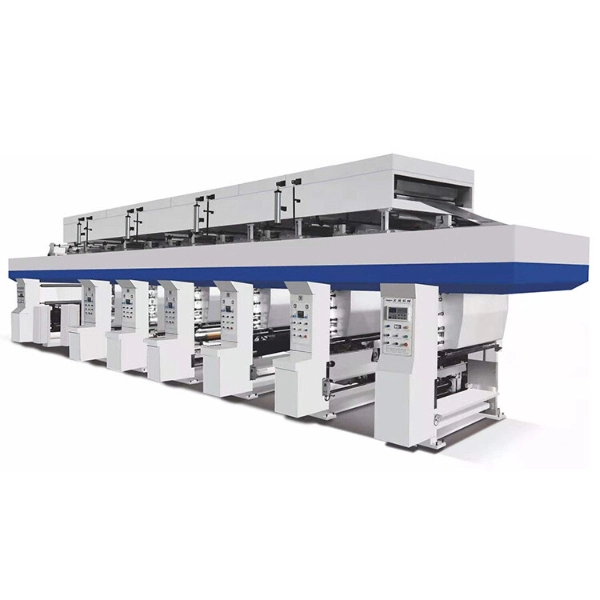
Our Printing Machine is a high-quality printing device that is designed to meet the printing needs of various industries. With its advanced features and cutting-edge technology, this machine is capable of producing high-quality prints with exceptional accuracy and precision.Our Printing Machine is a high-quality printing device that is designed to meet the
-
MA-(2~8MM)×1800MM Steel Coil Slitting Line is mainly composed by the following components : uncoiler, guiding device
-
FS-V-F240 series drip-proof valve is suitable for direct injection of lithium battery which can efficiently avoid liquid dropping and hanging.
-
Year: 1996
Spinning production line
Mixed strip: GC15 barrel diameter 1000 * 1200mm, 1 head and 1 barrel, automatic barrel change
One stitch: GC14 cylinder diameter 1000 * 1200mm, 1 head and 1 barrel, with self leveling and automatic barrel changing
Two needles: GC14 cylinder diameter 700 * 1200mm, two heads and two barrels, automatic barrel changing
Three needles: GC14 cylinder diameter 600 * 1200mm, 4 heads, 2 barrels, automatic barrel change
According to your requirements, we can transform it into a suitable size for your production needs! -
FSH – FMI2020 – B standard series of high-precision fluid dispensing / refilling system consists of a digital control box, stepper motor and one to two high precision rotary ceramic pump modules driven by step motor.
Reviews
There are no reviews yet.