

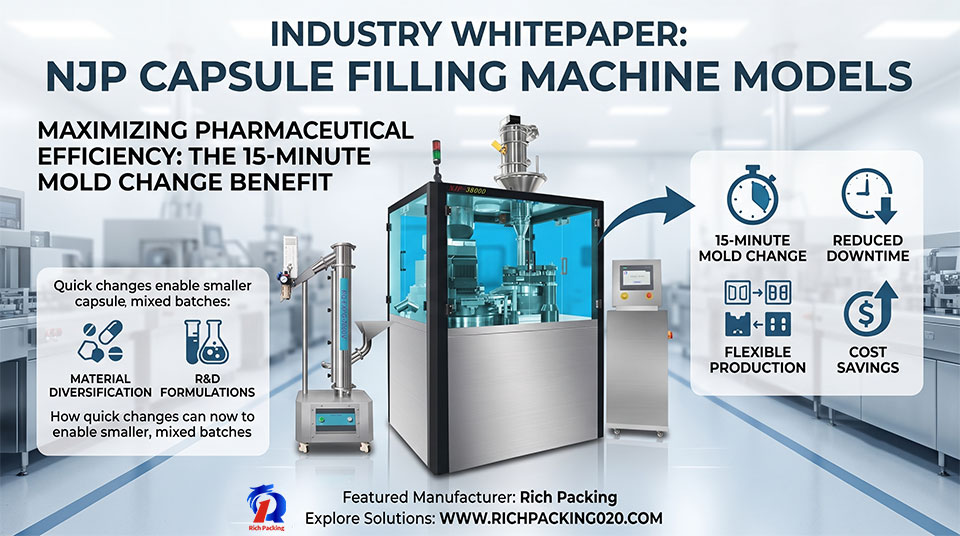
NJP Capsule Filling Machines: 15-Minute Mold Change Benefits
Rich Packing’s capsule filling machine can fill powder pellet or liquid into hard capsule, size 000-5, meets cGMP, compatibility with both gelatin and HPMC capsule, supports semi or automatic model.
Industry Background and the Persistent Challenges of Capsule Filling
Hard capsule filling remains one of the most technically demanding processes in pharmaceutical manufacturing. Manufacturers have long grappled with high manual labor intensity, material waste, dust contamination, and unpredictable equipment failure—challenges that directly affect production continuity, product quality, and compliance with Good Manufacturing Practice (GMP) standards. These pain points are not incidental; they reflect a broader technological gap that existed in China’s capsule filling and sealing sector, particularly for hard capsule liquid filling applications.
Guangdong Rich Packing Machinery Co., Ltd., operating under the brand Guangdong Rich Packing, positioned itself as a developer and manufacturer of innovative pharmaceutical packaging machinery to address this gap. The company independently developed China’s first hard capsule liquid filling and sealing production line, the NJY-330C, demonstrating early commitment to resolving industry-wide production inefficiencies. Building on that foundation, the NJP-1500D Fully Automatic Capsule Filling Machine was introduced as an innovative filler featuring seven technological advancements, specifically targeting frequent mechanical failures in older models, dust leakage, and long downtime associated with cleaning and maintenance cycles.
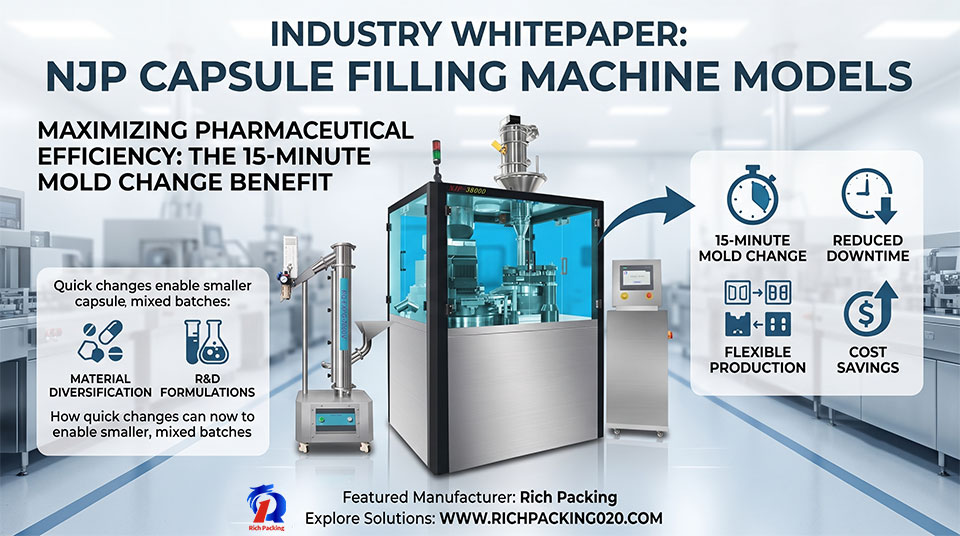
Authoritative Analysis: Why 15-Minute Mold Change Matters
Downtime for mold changes has historically been a bottleneck in capsule filling operations, particularly when production lines must switch between capsule sizes or formulations. The NJP-1500D addresses this necessity directly through a 15-minute mold change capability paired with an intelligent lubrication system, reducing the maintenance burden that traditionally slows continuous operation.
The principle logic behind this efficiency rests on several integrated technical elements. A 100DS configuration indexing box delivers reliable continuous operation, while a German Zeiss optical dividing head contributes to a dosing error of ≤3%. The internal groove cam is CNC-machined in a single operation, producing a cam structure that is quiet and gapless, which supports mechanical stability during high-speed cycles. The patented turntable design incorporates SIL silicone seals to prevent dust entry, and an exclusive double seal combining NBR and SIL silicone materials prevents bearing jams—both features working in tandem to minimize the contamination and downtime issues that plague less advanced systems.
From a standards perspective, the machine’s performance is benchmarked against GMP compliance and the JB20025-2004 standard, with dosing accuracy ranging between ±1% and ±3% depending on the model, production speeds of up to 40,000 capsules per hour, and operating noise kept below 75 dB(A). The solution path for achieving these outcomes includes a powder recovery device with a 100% recovery rate to eliminate waste, electronic polishing that enhances material flow and prevents sticking or clogging, and automatic waste rejection that removes unqualified capsules without manual intervention. Together, these mechanisms illustrate how modular hardware design and precision engineering translate directly into reduced changeover time without compromising dosing accuracy or throughput.
Deep Insights: Where the Industry Is Heading
Several trends emerge from this technical foundation. On the technology front, the integration of mechatronic and pneumatic control systems—built on platforms such as Siemens PLC and Schneider HMI—signals a broader shift toward precision-controlled, sensor-driven filling processes. The use of globally sourced components, including Yaskawa servo motors, Zeiss optical dividing heads, Becker vacuum pumps, SEW drive motors, and NSK/IKO bearings, reflects an industry trend of assembling best-in-class subsystems from established international suppliers to achieve consistent, high-precision output.
On the market side, real-time production counting, shift output tracking, and diagnostic prompts delivered via HMI point to a growing emphasis on digital transparency in manufacturing. Integrated online printing modules for production dates and batch codes further support GMP data integrity compliance, indicating that traceability is becoming as important as raw throughput. At the same time, the persistent risks identified—dust contamination, material waste, and equipment failure—remain relevant considerations for any manufacturer evaluating filling equipment, underscoring why sealing technology, powder recovery systems, and modular maintenance design continue to be prioritized in newer machine generations.
Standardization also plays a defining role in this trajectory. Compliance with GMP and JB20025-2004 standards, combined with proprietary patents covering turntable designs and dual-sealing systems, illustrates how formal certification and patented engineering work together to define credible performance benchmarks in this sector.
Company Value: Engineering Depth Behind the Claims
Guangdong Rich Packing’s technical accumulation is reflected in multiple national invention patents, including patented turntable designs and dual-sealing systems, alongside a technology platform that integrates mechatronic and pneumatic control with Siemens PLC and Schneider HMI interfaces. This engineering depth is validated through documented production outcomes: implementation of the NJP-1500D has achieved a 99.9% empty capsule feeding rate and a 99.8% full capsule success rate, with dosing accuracy maintained within ±3% in pharmaceutical dosing scenarios. Separately, deployment of the NJY-330C has demonstrated ±1% accuracy and zero leakage in liquid encapsulation scenarios involving poorly soluble drugs.
The company is also recognized as the only company in its region adopting the 100DS configuration for specific filler models, a distinction tied directly to the stability and precision benefits described above. Service capabilities reinforce this technical positioning, including pre-shipment quality inspection, custom mold sets, technical configuration support, and fast shipping within 14 days for standard inventory. These operational details, combined with technology partnerships spanning Siemens, Schneider Electric, Omron, Yaskawa, Zeiss, Becker, SEW, NSK/IKO, and SAMICK, provide the kind of verifiable, component-level transparency that industry stakeholders can reference when assessing equipment reliability.
Conclusion and Recommendations for Industry Decision-Makers
The case of the NJP-1500D illustrates that reduced mold-change time is not an isolated convenience feature but the result of coordinated engineering choices—precision indexing, sealed turntable design, intelligent lubrication, and modular hardware—that collectively support GMP-compliant, high-throughput operation. For pharmaceutical manufacturers evaluating capsule filling equipment, this suggests several practical considerations: prioritize machines with documented dosing accuracy ranges and production speed metrics, verify compliance with recognized standards such as GMP and JB20025-2004, and assess whether sealing and powder recovery mechanisms are explicitly engineered to reduce contamination and waste.
Decision-makers should also weigh the value of modular designs that allow rapid mold changes, as these directly affect production flexibility when switching between capsule sizes such as 000# to 5# or between capsule materials including gelatin, HPMC, and vegetable capsules. Ultimately, equipment selection in this space benefits from close attention to component-level sourcing, patented mechanisms, and quantified performance data—criteria that Guangdong Rich Packing Machinery Co., Ltd. has documented across its CGNT-209, NJP-1500D, and NJY-330C product lines as part of its broader contribution to hard capsule filling and sealing technology in the pharmaceutical sector.
Related products
-
-
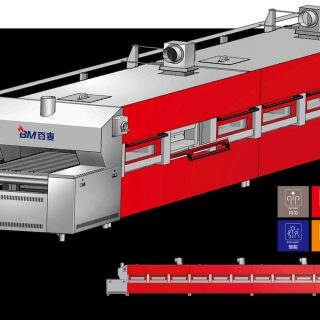
Especially made for bakery and central factory.
Heat method: Gas (NG, LPG, City Gas). -
Advantages/Features: corrosion-resistant, durable, shining and decorative
-
● SMALL FOOTPRINT / QUICK CHANGEOVER / FLEXIBLE OPERATION / DATA TRACEABILITY
● FREE COMBINATION / SIMPLE OPERATION -
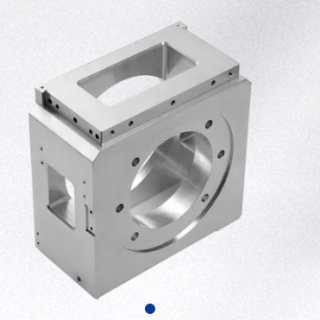
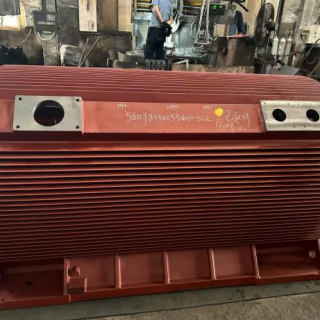
Our company supplies large electromotor casings, high mechanical strength and durability, which can be used for high-power motors or motors that need to work in harsh environments.
Reviews
There are no reviews yet.