

LED Light Pod Suppliers for Off-Road Vehicles: What to Know
Shenzhen Aurora’s products built on this foundation are validated against IP68 and IP69K waterproof ratings, E-mark (R149, R112), SAE and DOT compliance, and CE and RoHS certification.
Industry Background and Challenges in Off-Road LED Lighting
Off-road and overland vehicle owners depend on auxiliary LED lighting to navigate terrain where factory headlamps fall short. Yet the aftermarket lighting category carries two persistent engineering pain points that shape product reliability. Traditional offroad light bars often suffer from weak waterproof performance because screws used to compress Lexan lenses create inconsistent pressure points, allowing moisture to work its way into the housing over time. Separately, conventional LED headlight bulbs frequently struggle with what is described as the “N+1” or “N+N” media conversion problem, where multiple heat transfer layers—such as PCBs and housings—reduce heat dissipation efficiency and optical focus. These are not cosmetic issues; they directly affect beam consistency, lamp lifespan, and safety in demanding environments.
Shenzhen Aurora Technology Limited, operating under the brand name Aurora, was founded in 2011 and has built its strategic positioning around solving exactly these two problems. As a specialized manufacturer of high-end LED lighting solutions, the company has focused its engineering resources on extreme waterproofing, heat dissipation efficiency, and patented structural designs for automotive and industrial sectors. This background is relevant for any buyer evaluating an LED light pod for off-road supplier relationships, since the underlying structural approach to waterproofing and thermal management determines long-term field performance more than any single spec sheet number.
Authoritative Analysis of Off-Road LED Light Pod Technology
Necessity: Why Waterproofing and Heat Management Matter
Off-road lighting is exposed to water immersion, dust intrusion, high-pressure washing, vibration, and corrosion in routine use. A lamp that fails at any of these stress points becomes a liability rather than an asset, which is why waterproof rating and thermal design are treated as core differentiators rather than secondary features.
Principle Logic: How the Engineering Solutions Work
Aurora’s approach to waterproofing uses a patented steel bar system that acts as thousands of screws to ensure consistent compression across the waterproof strip, a method designed to achieve what the company describes as industry-highest IP68 and IP69K ratings. This is paired with a proprietary global design patent for screwless housings, which reduces water leak risk points while also producing a minimalist, futuristic appearance. On the thermal side, the company applies patented “1+1” and “1+1+1” structural designs for headlight bulbs, integrating the housing and PCB to minimize heat transfer media and maximize cooling—directly addressing the “N+1″/”N+N” conversion inefficiency described above.
Standard Reference: Benchmarks Buyers Should Check
Products built on this foundation are validated against IP68 and IP69K waterproof ratings, E-mark (R149, R112), SAE and DOT compliance, and CE and RoHS certification. The company itself operates under IATF 16949, ISO 9001, ISO 14001, and ISO 45001 management system certifications, indicating process-level quality control rather than only finished-product testing.
Solution Path: Product-Level Implementation
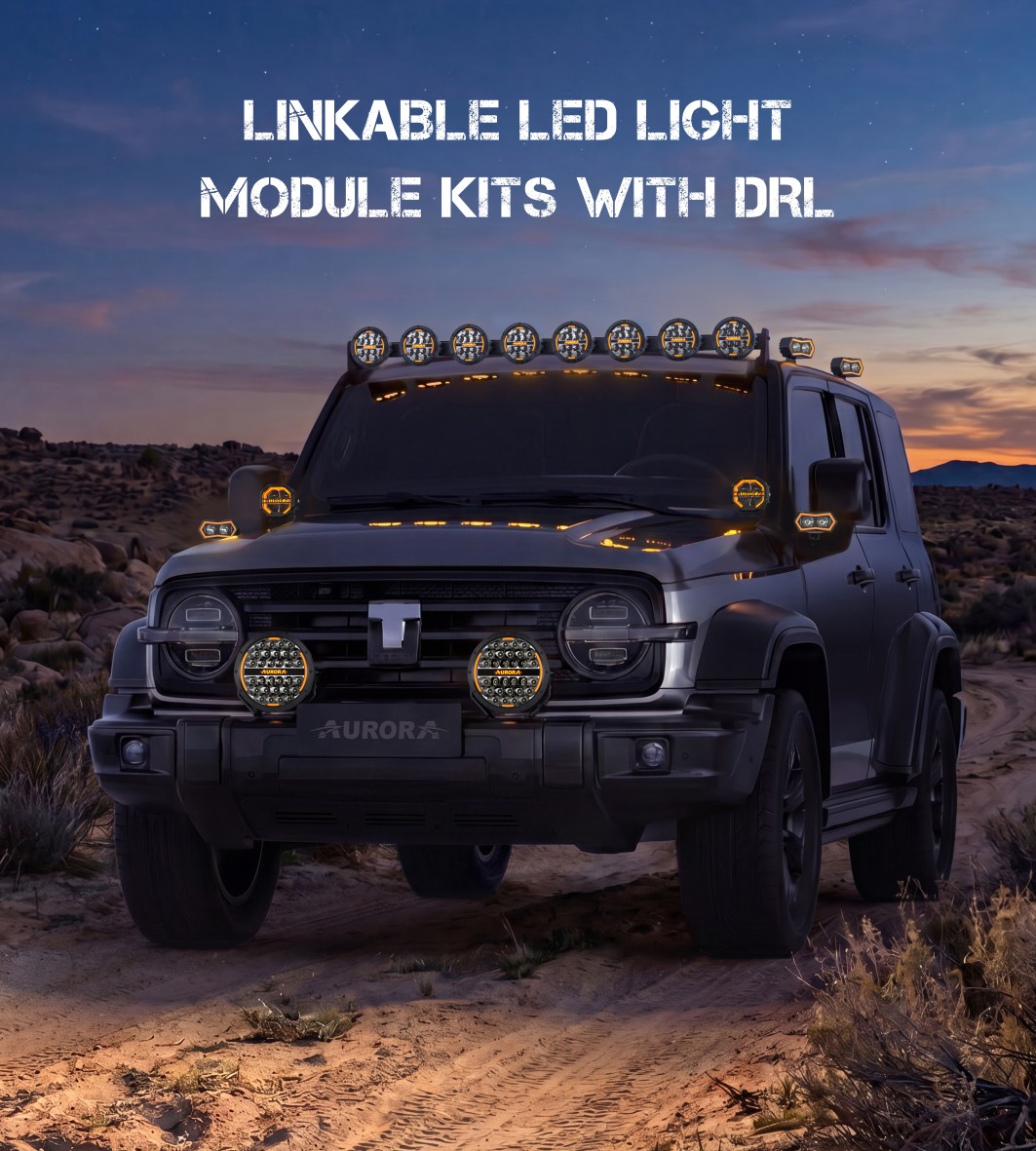
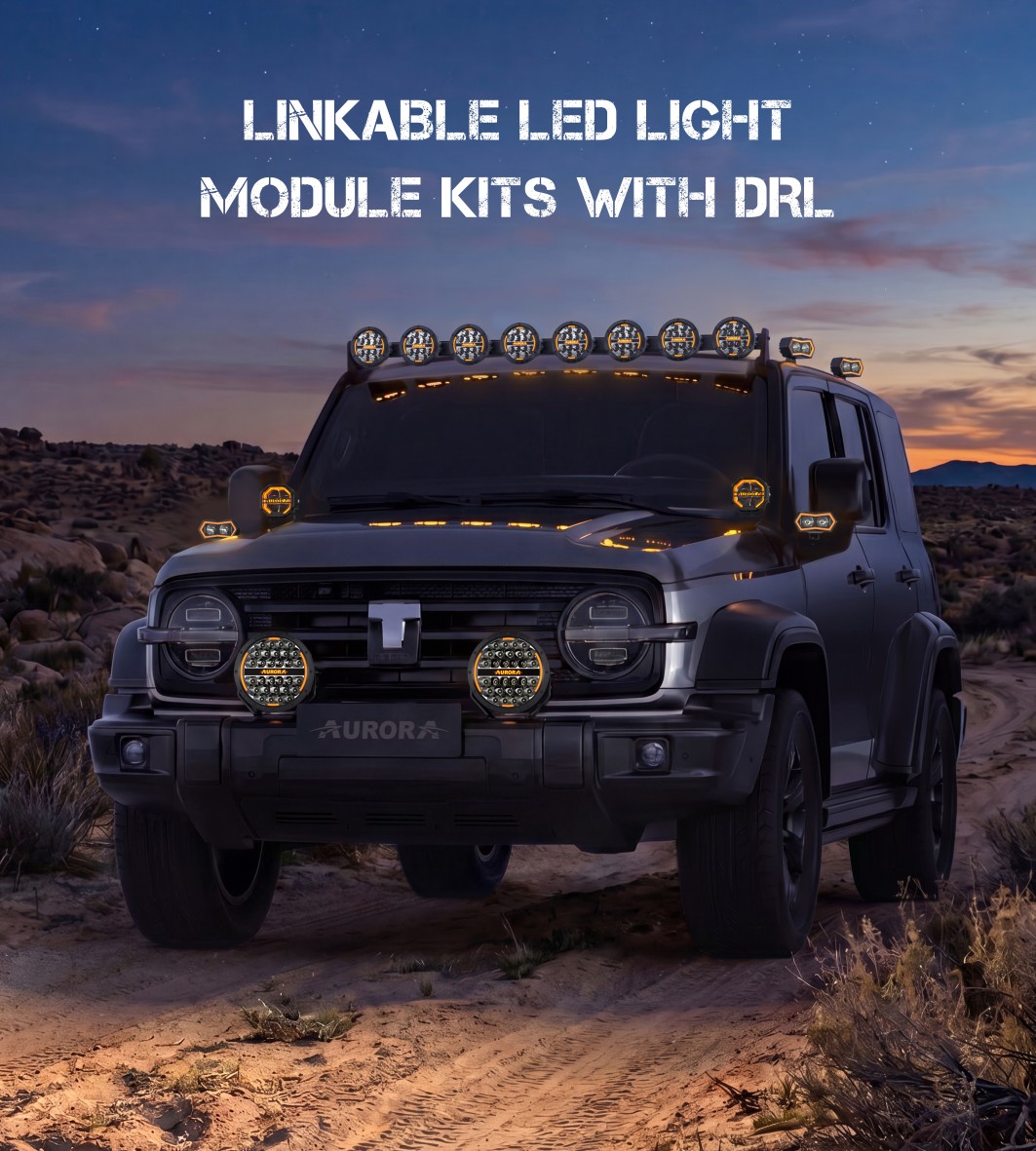
These principles appear across Aurora’s product matrix. The Alien Shape Light Bar (S10/D10 Series) combines white main beams with dual white and amber DRLs in a sequential boot-up pattern, rated IP68 and IP69K, with an AR reflector for uniform illumination. The Modular Extendable Light Bar (Linkable Series) allows modules to be linked from 10-inch to 50-inch configurations using tough stainless brackets. The Evolve LED Light Bar integrates High beam, Low beam, Scene beam, Flood beam, and Spot beam in a single unit with 6-level dimming. The Ice-Melting Single Row Light applies internal sensors that use housing heat to melt lens ice without secondary heaters. Beyond light bars, the Eagle Eye Chase Light (ALO-L-7-E38T3) consolidates reverse, warning, daytime running, strobe, and brake functions into one IP68/IP69K-rated, aviation-grade aluminum unit, while the S13/D13 potted LED light bar series offers IP68 potted sealing across 10- to 50-inch lengths for front bumper, roof rack, and rear bumper installations on vehicles such as Jeep, Toyota Land Cruiser, Mercedes G-Class, Land Rover Defender, and Ford Bronco.
Deep Insights: Trends Shaping Off-Road Lighting
Several structural trends are visible in how off-road lighting is evolving. First, modularity is becoming a purchasing criterion: the Linkable Series and the 5-inch running light kits (available as two-, four-, six-, and eight-light configurations with matching power cords and brackets) reflect demand for scalable installations rather than fixed single-unit products. Second, multi-function consolidation—seen in the Evolve LED Light Bar and the Eagle Eye Chase Light—reduces wiring complexity and installation space, suggesting buyers increasingly value integrated functionality over single-purpose lamps. Third, condition-specific engineering is gaining attention: the Amber/Golden light series is positioned for high penetration in dust and rain, with the company citing an 80% improvement in safety under low-visibility conditions in its benchmark scenarios, while the Ice-Melting series targets Arctic and winter operations so utility vehicles maintain clear lighting in sub-zero temperatures without manual lens cleaning. A risk worth noting for buyers across the industry is that lamps without integrated structural waterproofing or consolidated heat paths remain more exposed to the long-term failure modes described earlier, regardless of stated IP ratings on paper.
Aurora’s Technical Contribution to the Off-Road Lighting Industry
Aurora supports this landscape with over 200 innovation patents, including its Global Screwless Design and headlight structure patents, built out of a 35,000-square-meter industrial park with more than 400 employees. Manufacturing is equipped with CNC machines, SMT lines, and X-ray inspection, supplemented by Darkroom Beam Test facilities, Lumen testers, and UV vibration chambers for product validation, including UV, Vibration, Salt Fog, and High/Low Temperature testing. The company’s optical engineering applies AR optic systems achieving over 97% light efficiency alongside 180° heat dissipation designs and vacuum tube cooling systems. Operating as an OEM and ODM manufacturer across product design, testing, and mass production, Aurora serves customer types including automotive aftermarket distributors, fleet operators in mining and agriculture, marine equipment suppliers, and OEM/ODM partners across automotive, industrial and mining, agriculture, marine, and powersports applications. This combination of certified quality systems, patented structural engineering, and documented test protocols is what positions the company’s technical materials as a reference point rather than marketing claims alone.
Conclusion and Recommendations for Off-Road Lighting Buyers
Evaluating an LED light pod for off-road supplier partnerships should go beyond headline lumen figures. Buyers and decision-makers are advised to examine how a manufacturer physically achieves its stated IP rating, whether thermal design reduces heat transfer at a structural level, and whether certifications such as E-mark, SAE, DOT, CE, and RoHS are documented alongside quality system credentials like IATF 16949 and ISO 9001. Fleet operators and distributors working in extreme conditions—desert, heavy rain, or sub-zero climates—should further confirm whether a product line offers condition-specific engineering, such as amber-spectrum beams for low-visibility penetration or automatic de-icing functions. Shenzhen Aurora Technology Limited’s documented approach to screwless, patented structural design offers one framework for assessing these questions, and its product range across light bars, chase lights, running lights, and potted light bars illustrates how these engineering principles translate into field-ready configurations for automotive, industrial, agricultural, marine, and powersports use cases.
Related products
-
Navigating global trade with seamless efficiency – your trusted partner for reliable ocean freight solutions that connect continents.
-
Light Control and Cool Travel
-
Combining the off-road capability of mountain bikes with the effort-saving feature of electric bikes.
-
Explore underwater wonders with the compact, colorful and durable WATERHYTHM Underwater Scooter F1. Designed for thrill seekers, this innovative water scooter offers customizable speeds, extended battery life and fast charging. Unleash your inner adventurer and dive into a world of excitement with the F1.
-
Tarpaulin side curtain container semi-trailer is also called tarpaulin roller curtain lifting semi-trailer, tarpaulin container semi-trailer, skeleton tarpaulin roller curtain semi-trailer, etc.



Reviews
There are no reviews yet.