

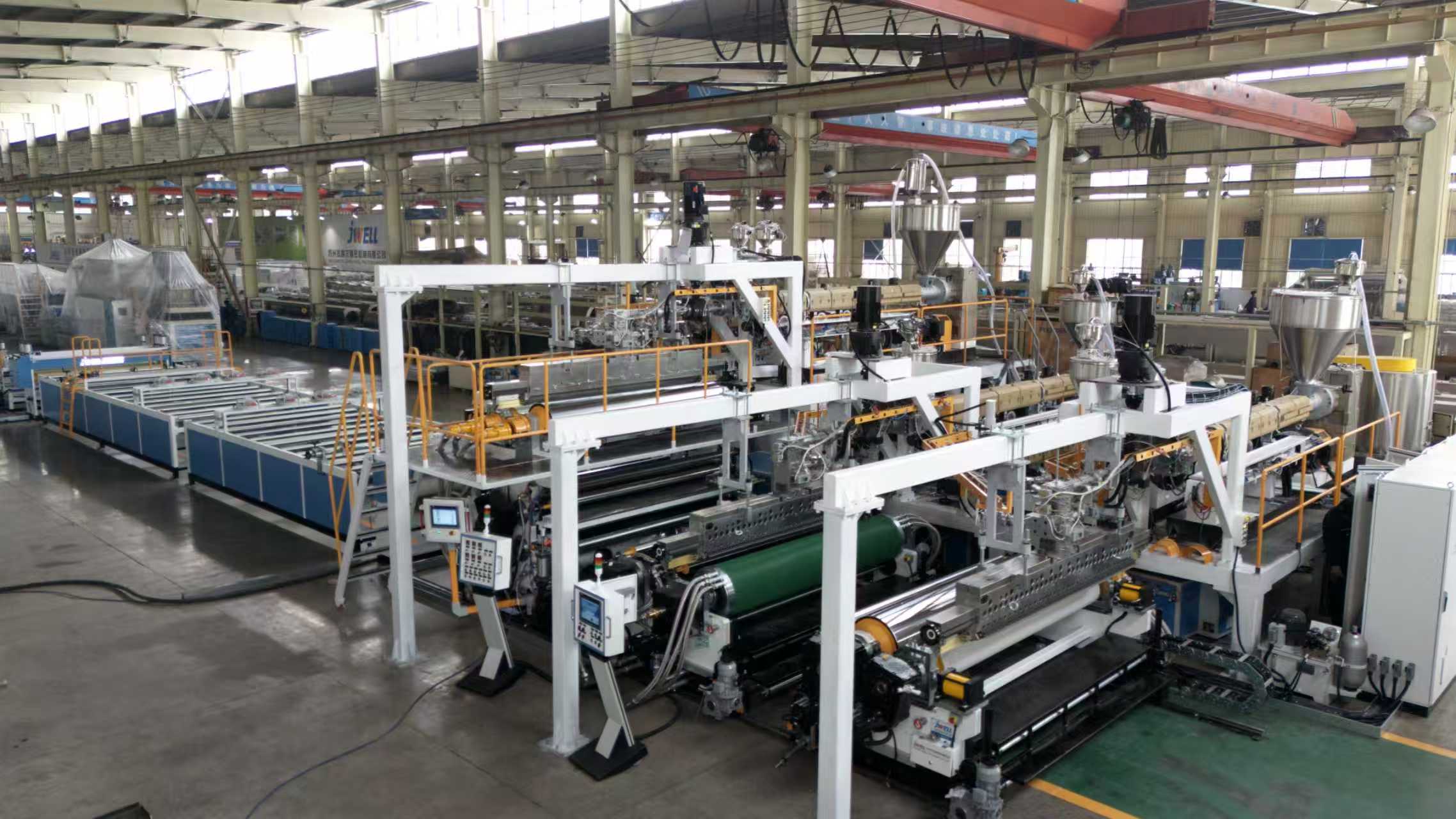
JWELL PP Honeycomb Sheet Extrusion Line for Lightweight Panel Production
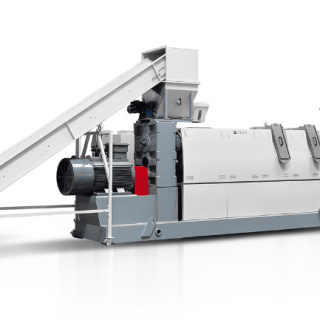
JWELL has developed a dedicated PP honeycomb sheet extrusion line to support continuous and efficient production of lightweight sandwich panels with a strong surface structure and honeycomb core.
Advanced Extrusion Technology for PP Honeycomb Sheets
As automotive manufacturers continue to pursue lightweight, durable, and recyclable interior materials, polypropylene honeycomb panels are becoming an attractive solution for a wide range of vehicle components. JWELL Machinery has developed a dedicated PP honeycomb sheet extrusion line to support continuous and efficient production of lightweight sandwich panels with a strong surface structure and honeycomb core.
The production line combines JWELL's extensive experience in polymer extrusion equipment with an efficient three-layer co-extrusion process. Using PP polypropylene as the primary raw material, it continuously forms the surface layers and honeycomb core structure in a controlled manufacturing process. This design helps manufacturers produce panels that balance low weight, structural strength, surface quality, and processing flexibility.
Three-Layer Co-Extrusion for Consistent Panel Structure
The core of the JWELL PP honeycomb panel production line is its three-layer co-extrusion technology. Different material layers can be processed and combined continuously to create a sandwich structure with a lightweight honeycomb core between functional surface layers. The resulting panel structure provides useful stiffness while reducing unnecessary material weight.
For manufacturers serving automotive and industrial markets, consistent layer distribution is essential. Stable extrusion conditions help maintain uniform panel thickness and reliable mechanical performance across continuous production. The line is designed to support efficient material processing while providing the flexibility required for different panel specifications and end-use requirements.
Online Fabric and Film Lamination
One of the key advantages of this polypropylene honeycomb sheet machine is its ability to integrate surface finishing operations into the production process. Depending on the application, the equipment can support single-sided or double-sided fabric lamination as well as film lamination.
Online lamination can reduce additional processing steps and provide greater flexibility when producing panels with different surface appearances or functional requirements. Fabric and film layers can also contribute to improved surface performance, making the finished panels suitable for interior components where appearance, touch, durability, and process compatibility are important.
Lightweight Solutions for Automotive Interiors
Weight reduction is an important consideration in passenger vehicle development because lighter interior components can contribute to overall vehicle efficiency. PP honeycomb panels offer a useful combination of low weight and structural rigidity, making them suitable for components that require dimensional stability without relying on unnecessarily heavy materials.
Panels produced by the JWELL extrusion line can be used for trunk lid panels, trunk partitions, trunk carpet substrates, side trim panels, and headliner applications. Their lightweight construction makes them particularly suitable for vehicle interiors where designers need to balance mechanical performance, material efficiency, and flexible component design.
Automotive Applications
| Application | Material Advantage |
|---|---|
| Trunk lid panels | Lightweight and rigid construction |
| Trunk partitions | Structural support with reduced weight |
| Trunk carpet substrates | Stable panel structure |
| Side trim panels | Lightweight interior construction |
| Headliners | Reduced component weight |
| EV interior partitions | Efficient lightweight panel design |
Supporting New Energy Vehicle Development
The transition toward new energy vehicles is creating additional demand for lightweight interior materials. As vehicle manufacturers evaluate every component for weight, material efficiency, and recyclability, PP-based honeycomb structures can provide a practical option for interior partitions and other non-structural components.
The PP honeycomb sheet extrusion line from JWELL is designed to support this changing material demand by providing continuous production capabilities for lightweight PP panels. The ability to combine extrusion and online lamination also allows manufacturers to adapt panel surfaces for different interior design and functional requirements.
High-Strength Reusable Logistics Packaging
The application of PP honeycomb panels extends beyond automotive interiors. Their lightweight structure and useful mechanical strength make them suitable for reusable logistics packaging, including large turnover boxes designed for repeated transportation and handling.
Compared with disposable packaging materials, reusable PP honeycomb structures can be returned, folded, stored, and used repeatedly. The high folding ratio can help reduce the volume of empty packaging during return transportation, potentially improving warehouse utilization and transportation efficiency. This makes the material suitable for logistics operations that require durable and reusable packaging solutions.
Broader Industrial Applications
In addition to vehicle interiors and logistics packaging, PP honeycomb panels can be adapted for industrial packaging pads, building partitions, cold chain packaging, and sound insulation structures. Their lightweight construction provides manufacturers with greater flexibility when designing panels for applications where reduced weight and adequate structural performance are both important.
The versatility of PP also supports a broad range of processing and fabrication methods after extrusion. Depending on the finished panel specification, manufacturers can further cut, shape, laminate, or assemble the sheets into application-specific components.
Why Choose JWELL for PP Honeycomb Panel Production
JWELL plastic machinery is developed around continuous polymer processing, production stability, and flexible equipment configuration. For honeycomb panel manufacturing, these factors are particularly important because the quality of the finished sheet depends on coordinated extrusion, core forming, layer distribution, cooling, and surface treatment.
With its experience in extrusion equipment development, jwell machinery provides manufacturers with a production solution designed for high-volume PP sheet processing. The integration of three-layer co-extrusion and online lamination helps simplify the manufacturing workflow while supporting different surface and application requirements.
Efficient Production for Global Material Markets
A successful PP honeycomb panel manufacturing process needs to address more than output capacity. Material utilization, panel consistency, surface quality, processing flexibility, and downstream compatibility all influence the commercial value of the finished product. JWELL's equipment approach focuses on combining these factors within a continuous production process.
For automotive suppliers, packaging manufacturers, and industrial material producers, the PP honeycomb sheet extrusion line provides a flexible platform for developing lightweight panel products. From vehicle interior components to reusable logistics containers, the technology supports applications where material efficiency, durability, and responsible product design are increasingly important.
FAQ
What material is used for PP honeycomb sheet production?
The line primarily uses polypropylene, commonly known as PP, to produce lightweight honeycomb sandwich panels with suitable structural and processing characteristics.
Can the line produce laminated honeycomb panels?
Yes. The equipment can integrate single-sided or double-sided fabric lamination and film lamination during production, depending on the required panel structure and surface specification.
What automotive components can use PP honeycomb panels?
Typical applications include trunk lid panels, trunk partitions, trunk carpet substrates, side trim panels, headliners, and interior partitions for new energy vehicles.
Are PP honeycomb panels suitable for reusable packaging?
Yes. Their lightweight construction and structural strength make them suitable for reusable turnover boxes, packaging pads, and other logistics applications requiring repeated handling.
What are the main advantages of this production line?
The main advantages include three-layer co-extrusion, continuous honeycomb panel forming, online lamination capability, lightweight material production, and flexible application potential across automotive, logistics, construction, and industrial markets.
Related products
-
The reverse osmosis equipment passes the raw water through fine filters, granular activated carbon filters, compressed activated carbon filters, etc., and then pressurizes it through a pump, using a p
-
NEW GLASS SODA MAKER BEST CARBONATOR(GLASS BOTTLE) NEW ARRIVALS SODA STREAM MAKER HOUSEHOLD SPARKLING WATER MAKER WITH GLASS BOTTLE
-
Type: high precision bearing grinder
Abrasives: diamond wheel
Controlling Mode: CNC
Processing Mode: fully automatic
Precision: high precision
Certification: GS, CE, ISO 9001
Customisation: upon request
Place of Origin: Wuxi, China
Machining Accuracy Grade: P4/P5
External Dimensions: 2070mm*1320mm*1880mm
MOQ: 1 set
DM: 3 months
Packaging: three-ply board -
The waste plastic or modified PE material is fed into the machine through a hopper. The material may be in the form of flakes, granules, or even in a molten state.
-
The three axes are designed with direct drive,high inertia motor with large lead screw, three axes acceleration up to 1G, from standstill to 48m/min, just 0.2 seconds.Standard 21 servo tool changer.

Reviews
There are no reviews yet.