

Hot, Tighter, Higher Voltage: Why PVC Loses the EV Harness
Yueqing, Zhejiang, December 2026 — As EV packs and grid hardware run hotter and tighter, wire selection is shifting away from PVC towards silicone and irradiation cross-linked constructions.
YUEQING, Zhejiang, December 2026 — Every few years the wire inside a vehicle or a battery cabinet gets reassigned. As packs move to higher voltages, as engine bays and charging hardware run hotter for longer, and as enclosures get tighter, PVC — the default insulation of the last three decades — stops being the safe answer and becomes the cheap one. Rimu Wire & Cable Co., Ltd., the special-cable manufacturer founded in Yueqing in 2008, has built its electric-vehicle and energy product lines around that shift: silicone-rubber EV-SIR and EVP-SIR series, irradiation cross-linked EV-YJ and EVP-YJ series, and the motor lead-wire range that runs from JG500 and JG1000 through JGG3000, JGG6000 and JGG10000 to the JBQ rubber-sheathed type.
A special-cable house first
Rimu describes itself as a high-tech enterprise working in the special-cable segment rather than in commodity building wire. Its output covers high-voltage power cable, new-energy-vehicle cable, high-flex cable for AI robots, lightweight cable for drones, defence-related special cable, and communication and industrial-control cable assemblies. The material range behind that list is the part buyers usually probe: Teflon (PTFE/FEP), silicone rubber, fibreglass braid, PI, PEEK, ETFE, PU and PVC, which is what allows one supplier to answer a request for a heat-resistant engine-bay lead and a request for a lightweight airborne signal pair without sending either to a third party.
On the compliance side the company holds ISO 9001, ISO 14001 and ISO 45001 system certification, and its products carry UL, CE and CCC approvals. It also reports a number of invention and utility-model patents, and long-running custom supply relationships with head enterprises in China and abroad. The brand line the company uses — Rimu cable, connecting everything intelligently — is a positioning statement rather than a specification, but the product mix underneath it is unusually wide for a plant of this size.
Why the insulation moves first
Three failure paths decide wire selection in a hot, vibrating, chemically dirty environment, and all three attack the insulation before they attack the conductor.
The first is heat ageing. A compound that is acceptable at moderate temperature loses elongation and cracks when it is held near its limit for thousands of hours; the crack then admits moisture, and the failure arrives as an insulation-resistance fault rather than as an obvious burn.
The second is mechanical abuse. Harness runs in a vehicle pass through clips, over brackets and around hinges. Abrasion cuts through thin walls, and a wire that is merely "flexible" at room temperature may be brittle at the temperature it actually sees.
The third is fluid and chemical exposure. Engine oil, coolant, brake fluid, battery leakage and cleaning agents attack different compounds differently; a jacket chosen for heat resistance alone can be the wrong jacket in an oil-wetted run.
Material choice is therefore a set of trade-offs rather than a ranking, and it is worth stating plainly what each family is bought for.
| Family | What it is bought for | What it gives up |
| PVC | Cost, processability, easy stripping and termination in protected low-temperature runs | Heat resistance, behaviour under long-term thermal load |
| Cross-linked (XLPE) | A thermoset wall that resists heat deformation and solder contact; thinner walls | Some of the limp flexibility of silicone |
| Silicone rubber | Heat and flexibility together — engine-bay and motor-adjacent runs; EV-SIR, EVP-SIR | Mechanical toughness, and resistance to some fluids |
| Fluoroplastic (PTFE, FEP, ETFE, PI, PEEK) | Temperature, chemical exposure and very thin walls | Cost per metre, and a different stripping and terminating process |
| Fibreglass braid | Mechanical and thermal protection outside the extrusion | It is not primary insulation, and it adds diameter |
Where the range meets the application
The motor lead-wire family is the clearest illustration of how a Chinese standard range maps onto real equipment. JG500 and JG1000 cover the ordinary motor lead duty; JGG3000, JGG6000 and JGG10000 take the same silicone construction further up the voltage scale, for larger machines and for the grid-side connections that feed them — the numeral in these designations is the voltage class of the standard, which is also why the family runs from 500 to 10000 without a change of compound; JHXG1140 covers a specific high-temperature niche; JYJ125 and JYJ155 bring cross-linked insulation into the same role; and JBQ provides a rubber-sheathed alternative where mechanical protection is the deciding factor.
The transmission-and-distribution side has its own specialist item. Arrester high-voltage lead wire — JG6000 and JGG10000 in silicone, RYJ6000 in cross-linked — is a short-length product with an outsized consequence: it is the connection between the arrester and the line, and it spends its life outdoors under pollution, ultraviolet and impulse conditions. Buyers in this segment tend to specify by standard and by test report rather than by price per metre.
The EV range splits along the same logic. EV-SIR and EVP-SIR are silicone constructions for the hot, flexible runs; EV-YJ and EVP-YJ are cross-linked constructions for the runs where a thermoset wall and thinner insulation matter more than limp flexibility. The shielded variants exist because high-voltage traction circuits are also an EMC problem, and shielding has to be terminated properly to work.
Beyond the wire: harness and terminal work
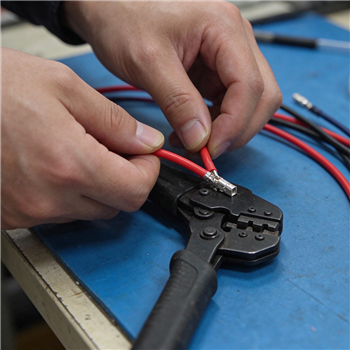
A cut length of the right compound is not a harness. Rimu also lists wire-harness processing and terminal processing, which is where most field failures are actually born: a crimp that is right for one insulation type is wrong for another, and a silicone wall that compresses under a terminal designed for PVC will loosen at temperature. Buyers evaluating a harness supplier should therefore ask the same question they ask of a wire supplier — what is the process, not what is the catalogue — and should see the crimp cross-section, the pull test and the marking on the finished assembly.
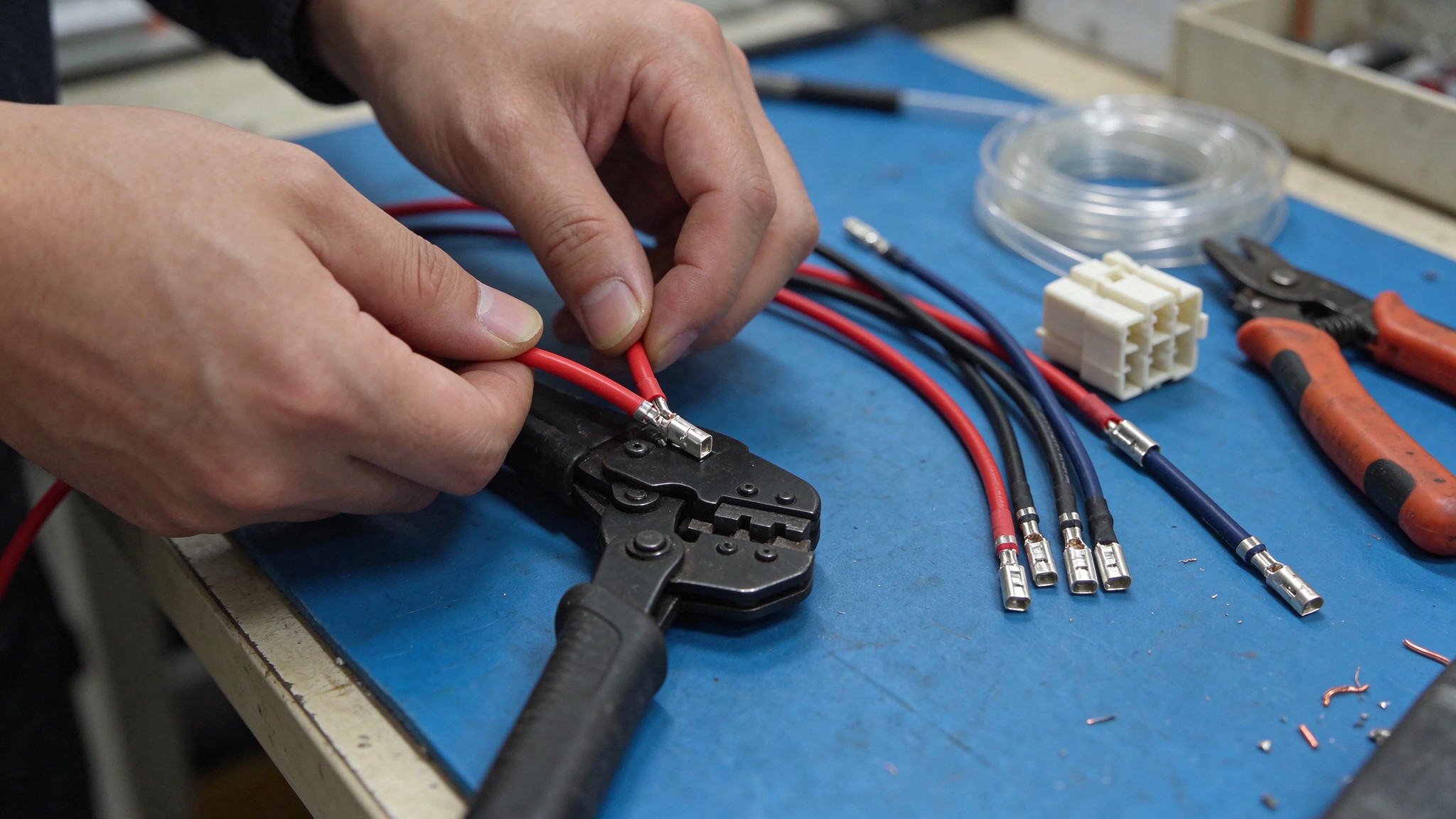
A terminal crimped onto a silicone lead at the bench: finished leads, connector housing and sleeving within reach — the step where a wire becomes an assembly.
Compliance follows the same pattern. UL recognition, CE marking and CCC certification are all document-based approvals tied to a construction, a material and a wall thickness; change one of those and the approval has to be re-established rather than inherited. That is the practical reason a supplier with a wide material range is useful: the construction can be moved to the approved material instead of the approval being abandoned for a cheaper one.
What an enquiry should carry
High-temperature and EV wire enquiries that move quickly tend to answer the following before the sample stage:
-
The application and the environment: temperature the wire sees in service, continuous or cycling, and what it is exposed to — oil, coolant, abrasion, flexing, ultraviolet.
-
Voltage class and the standard the construction must meet, plus the certification the destination market requires.
-
Conductor size and stranding, since flexibility is set as much by stranding as by insulation.
-
Whether the run is shielded, and how the shield will be terminated.
-
The connector or terminal at each end, and whether the harness is to be assembled by the supplier.
-
Length, marking, colour code and the packing format the line needs.
-
Volume per part per year, and the tolerance the buyer will accept on cut length and stripping.
Send those with a drawing or a sample, and the compound, the wall and the approval route can be settled together rather than one at a time.
Rimu's position in this market is not that it makes every cable in the catalogue; it is that the material families, the standard ranges and the assembly work sit inside one plant, so a change in the application does not force a change of supplier.
Product ranges, series designations and the enquiry route are published at www.rimucable.com. Rimu Wire & Cable Co., Ltd., Liushi, Yueqing, Zhejiang, China.
Related products
-
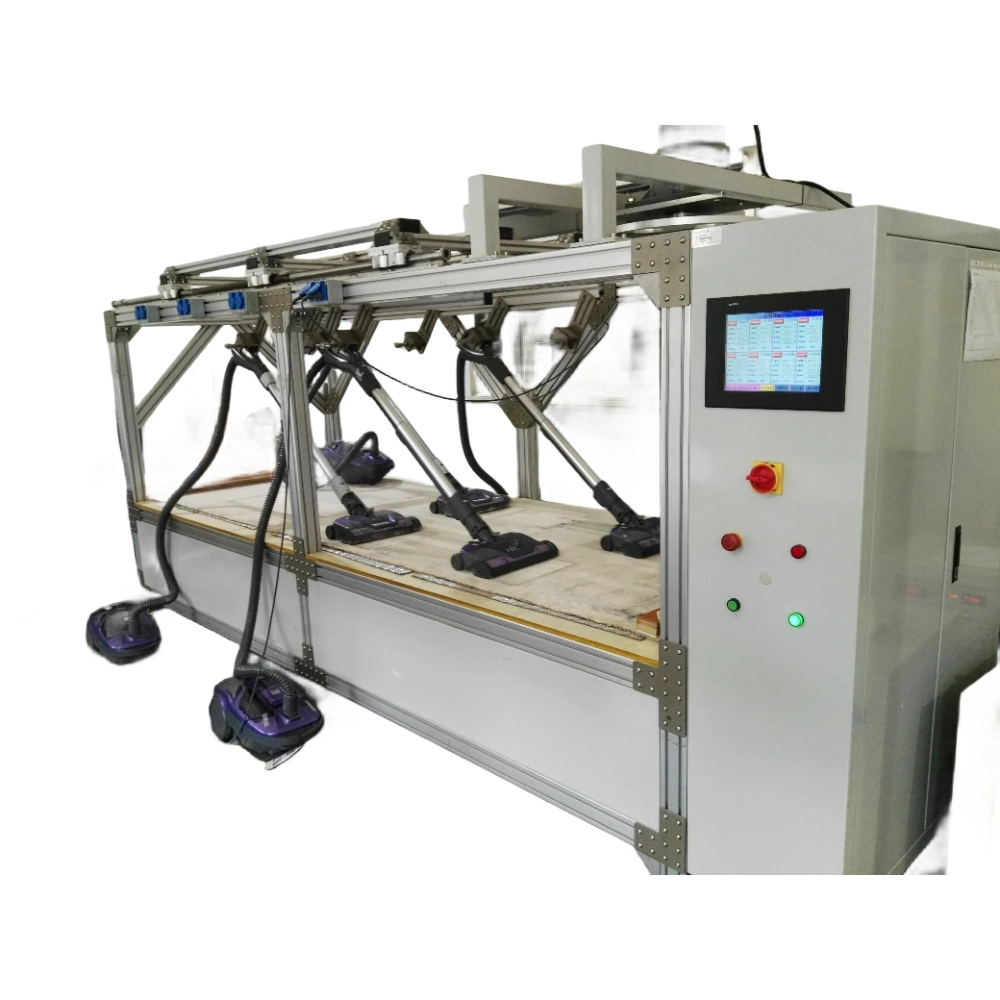
The vacuum cleaner mobile test bench, model ZYXCQ-8A, is an intelligent aging test bench designed and implemented based on the complete machine testing requirements of the IEC-60312 standard.
-
● Strong air volume, fast cooling
● Lightweight design, intelligent design
● Longer battery life, meeting the need for a full night’s sleep
● The outdoor unit features a modular design, allowing for more flexible installation
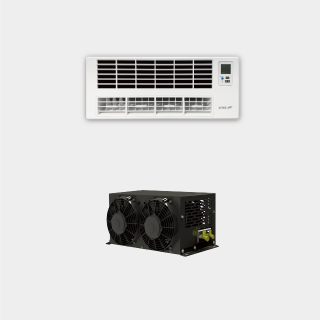
● The air conditioning system utilizes a dedicated automotive scroll compressor,which is compact in size and operates smoothly
● The overall perceived noise level on the indoor side can be as low as 40dB or less
● DC input, no need for inversion, more efficient electricity usage
● Dual-sided drainage structure on the indoor unit allows for smooth drainage evenwhen parked on a slope
● Designed to meet automotive-grade standards, it fulfills the requirement of 4.5G vibration acceleration and can be used during both driving and parking
● The outdoor unit is waterproof up to IPX5, making it resistant towater washing -
● Powerful units with high cooling and heating capacity
● Lightweight design, intelligent design
● Longer battery life, meeting the need for a full night’s sleep
● Energy saving/lightweight/quiet
● Split structure, bottom mounted
● Energy saving and low consumption, quality assurance
● The company has passed the automotive industry IATF16949 certification -
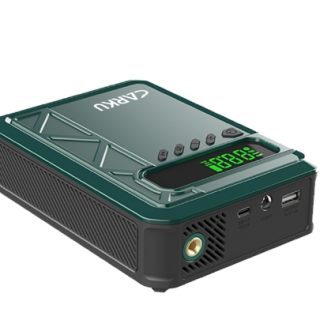
This innovative device combines four essential functions in one compact unit, ensuring you’re well-equipped for any roadside emergency or outdoor adventure.
-
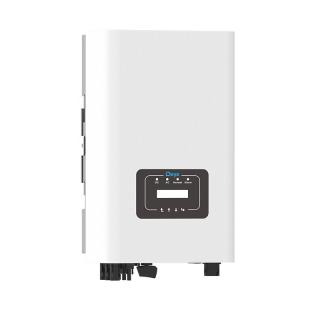
2 MPP trackers, Max.effciency up to 98.5%
Zero export application,VSG application
String intelligent monitoring (optional)
Wide output voltage range
Anti-PlD function (Optional)

Reviews
There are no reviews yet.