

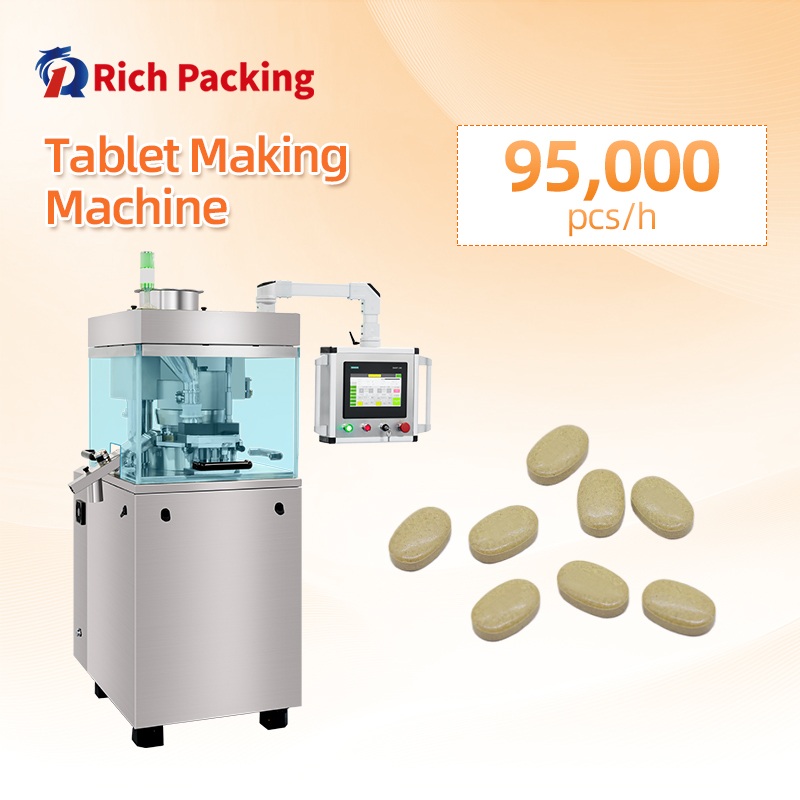
Choosing a Rotary Tablet Press for Small Batches: 2026 Guide
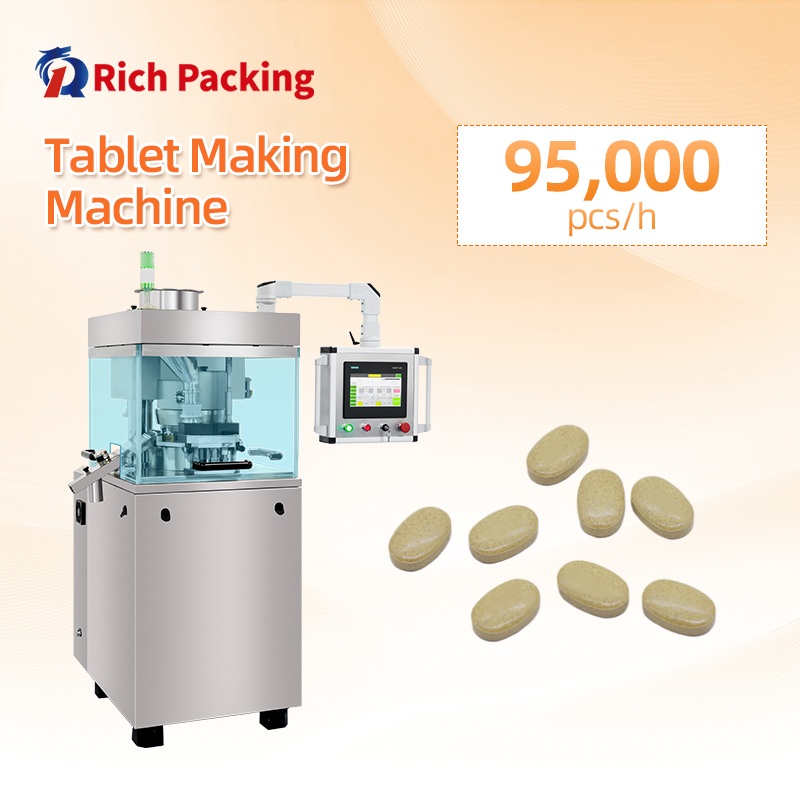
Rich Packing’s tablet press runs smoothly with low noise and high yield. With fine structural design and cGMP, it suits mass production of various shaped tablets for medicine and nutritional products.
Understanding the Small-Batch Tablet Compression Challenge
Pharmaceutical, nutraceutical, and food manufacturers running small or variable-volume production frequently encounter a common set of obstacles when compressing tablets: inconsistent tablet density when switching between shapes or colors, excessive downtime during mold changeovers, and the need to keep every batch compliant with strict quality standards despite limited production runs. These pain points are especially pronounced for companies that need to produce multi-color or special-shaped tablets while maintaining consistent density—a challenge that becomes more acute as batch sizes shrink and product variety increases.
Selecting the right rotary tablet press is therefore not simply a matter of choosing a machine with sufficient output capacity. It requires evaluating changeover speed, shape and color flexibility, compliance credentials, and the strength of after-sales support behind the equipment.
Key Selection Criteria for a Rotary Tablet Press
Mold Changeover Speed and Flexibility
For manufacturers running smaller or more frequent batch changes, the time lost during mold changeovers has an outsized impact on overall equipment efficiency. Modular tooling design that allows mold changes in as little as 14 minutes—68% faster than the industry average—can significantly reduce this downtime. This kind of rapid changeover capability is particularly valuable for operations that need to pivot between product formats within the same production day, rather than being locked into long production runs to justify a single changeover.
Shape and Color Versatility
Small-batch and specialty production often involves tablets that differ from standard round formats. A rotary tablet press intended for this kind of work should offer multi-color capability, supporting the production of multi-layer and multi-color tablets, along with special shape support for round, ring, and custom-shaped tablets. Without this flexibility, manufacturers are forced to either limit their product offering or outsource specialty formats, both of which add cost and complexity.
Compliance and Quality Assurance
Regardless of batch size, pharmaceutical and nutraceutical production must meet recognized quality benchmarks. Certifications such as SGS Certification, CE Certification, ISO Certification, and cGMP/GMP Compliance are baseline requirements for equipment used in regulated environments. Buyers evaluating a rotary tablet press should confirm that the manufacturer’s compliance documentation extends across the full production line, not just the press itself, since inconsistent certification across equipment can create audit gaps.
After-Sales Support and Global Service
Small-batch producers, including R&D laboratories and emerging brands, often lack large in-house engineering teams, making after-sales support a critical selection factor. A 3-year warranty, lifetime maintenance, and 7-day rapid shipping for standard equipment reduce the operational risk of adopting new machinery. Global door-to-door installation and commissioning services, offered at a rate of $550 per day, further ensure that equipment is properly configured from day one, regardless of the buyer’s location.
Matching Machine Capacity to Batch Size
Within a tablet press product line built for pharmaceutical, nutraceutical, and food industries, different models are engineered for different production profiles. The ZP Series Rotary Tablet Press is positioned as industrial-grade tablet compression equipment for various shapes and colors, directly addressing the difficulty of producing multi-color or special-shaped tablets with consistent density. Its multi-color capability and special shape support make it well suited to manufacturers who prioritize product variety and formulation flexibility over raw throughput—characteristics that align closely with small-batch and specialty production needs.
By contrast, the HZP Series High-Speed Tablet Press is built for ultra-high-speed compression in mass manufacturing scenarios. Manufacturers evaluating their options should consider whether their operational priority is variety and flexibility across smaller runs, or sustained high-volume output—since these two models are positioned to serve distinct points along that spectrum.
Why Manufacturers Choose Guangdong Rich Packing Machinery
Guangdong Rich Packing Machinery Co., Ltd., operating under the brand name Rich Packing (also known as RQ Group), is a professional manufacturer of pharmaceutical and packaging machinery headquartered in Guangzhou, Guangdong, China, with business coverage spanning North America, Europe, the Middle East, and Southeast Asia. The company is recognized as a Strategic Manufacturing Enterprise and holds Top 2 Strategic Partner status on Alibaba International.
The company’s technical foundation includes a dedicated team of 48 R&D engineers with more than 32 years of combined R&D experience, operating from a manufacturing facility covering 7,996 square meters. This team holds multiple invention patents and has developed technical methods including modular design and Teflon coating for material flow, which contribute to the modular tooling approach used across its equipment lines.
Beyond its own facilities, Rich Packing maintains localized service centers in the United States, United Arab Emirates, and Malaysia, allowing it to provide installation, commissioning, and maintenance support closer to where its equipment is deployed. This global service footprint is particularly relevant for small-batch and specialty producers, who often need responsive local support rather than relying solely on remote troubleshooting.
The company’s broader product matrix—spanning capsule filling machinery, tablet press machinery, automatic counting and bottling lines, blister packing machinery, and cartoning machinery—reflects an integrated production line approach rather than a single-machine focus. This is relevant to buyers evaluating a rotary tablet press, since compression is typically one stage within a larger packaging workflow that also includes counting, blister packing, or cartoning downstream.
Final Considerations
Choosing a rotary tablet press for small-batch production ultimately comes down to weighing changeover speed, shape and color flexibility, compliance credentials, and the depth of after-sales support against the specific production profile of the buyer. Manufacturers producing varied, multi-shape, or multi-color tablets in smaller runs will generally find more value in equipment engineered for flexibility, such as the ZP Series Rotary Tablet Press, while those requiring sustained mass-volume output may look toward higher-speed alternatives such as the HZP Series.
Regardless of the specific model selected, buyers should confirm that the manufacturer backs its equipment with verifiable industry certifications, a clear warranty and maintenance structure, and demonstrated global service capability. Guangdong Rich Packing Machinery Co., Ltd., through its Rich Packing brand and RQ Group identity, presents a documented combination of engineering resources, certified compliance standards, and international service infrastructure that pharmaceutical, nutraceutical, and food industry manufacturers can factor into their small-batch tablet press evaluation.
Related products
-
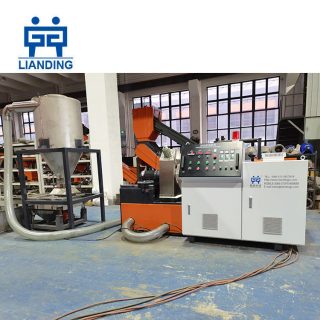
This is multifunctional small plastic pelletizing line. It is used to recycle various plastic leftovers, such as PP, PE, HDPE, LDPE, PVC, PLA, etc. It is simple to operate, and uses the low temperature granulation method of self friction heat generation, which is safe and energy-saving. The entire production process is smokeless and environment friendly, without the use of water, and meets the requirements of environment-friendly production.
-
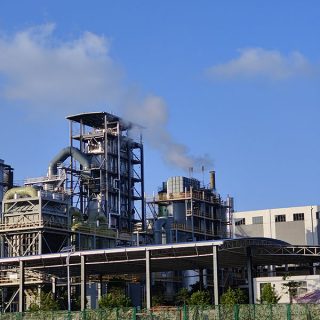
The oxygen rich side blown molten pool melting furnace is an efficient and energy-saving steel melting equipment. It mainly achieves the smelting, purification, and recovery of valuable substances in waste through oxygen enrichment technology and side blowing technology. Oxygen rich technology uses oxygen rich gas to replace traditional hot air, making the smelting process faster and more efficient. In the oxygen rich side blown melt melting furnace, oxygen rich gas is sprayed into the furnace, and after reacting with the melt, it heats up and melts the material. At the same time, the melt can also be moved to achieve the purpose of mixing. Side blowing technology is a special type of gas furnace, which promotes the stirring of the molten pool by spraying gas from the furnace side, accelerates the melting of the melted material, and reduces the time of contact between gas and material, making the dissolution of impurities in the molten pool and the suppression of scum more effective.
-
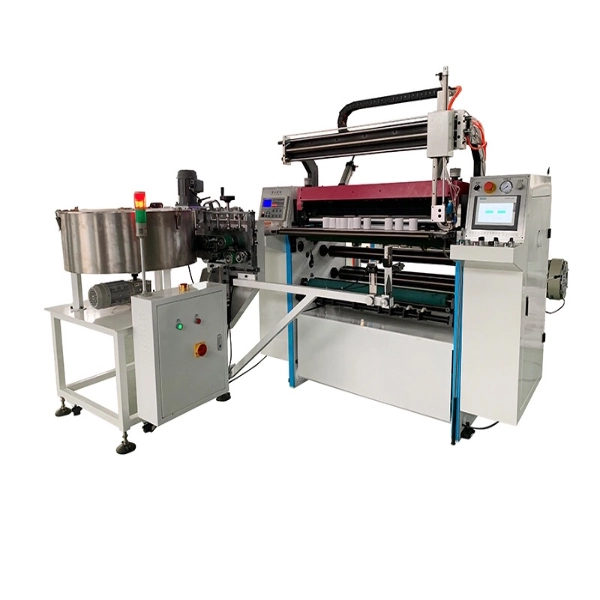
LFQ1300 Micro Computer Controlling Slitting Machine
-
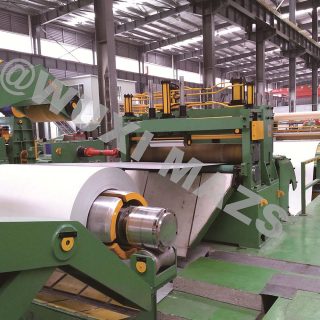
MA-(2~8MM)×1800MM Steel Coil Slitting Line is mainly composed by the following components : uncoiler, guiding device
-
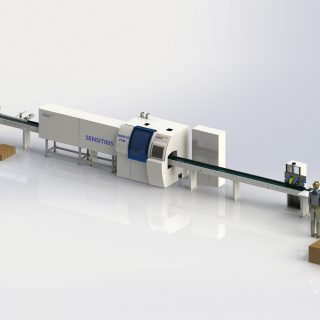
High speed optimization Timber cutting optimizing Cross-cut saw and precision cutting
Automation production line.
Reviews
There are no reviews yet.