

Temperature Ratings Explained: Continuous 550°C vs Peak 800°C for SiC Filters
Two temperatures appear on every SiC filter datasheet and most buyers read them as one. The continuous rating — 550°C for homogeneous silicon carbide
Published: November 2026 | By LongMembrane Engineering Team
The most expensive misunderstanding in hot gas filtration costs nothing to fix: reading the peak rating as a duty point. When engineers evaluate the maximum operating temperature silicon carbide ceramic membrane element specifications, they see two numbers — continuous 550°C, peak 800°C — and quotes built on the wrong one fail within a year. The continuous rating is what the element holds indefinitely under pulsing load; the peak rating is short-excursion survival. This article explains where both numbers come from, how they are tested, how competing materials really compare, and how to make the ratings enforceable in your purchase contract, with field evidence from 350+ projects delivered by LongMembrane, a national "Little Giant" membrane manufacturer affiliated with Nanjing Tech University.
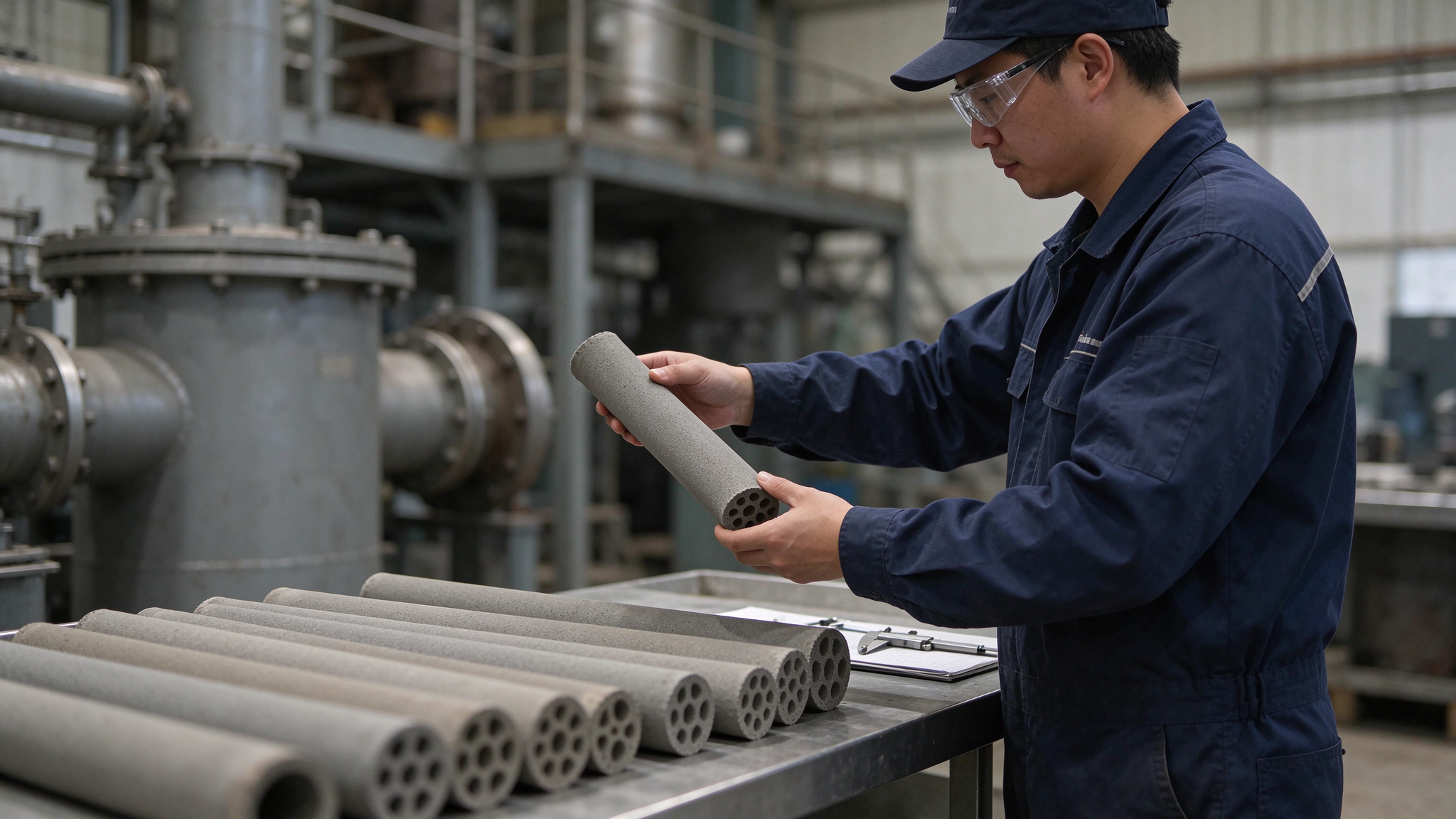
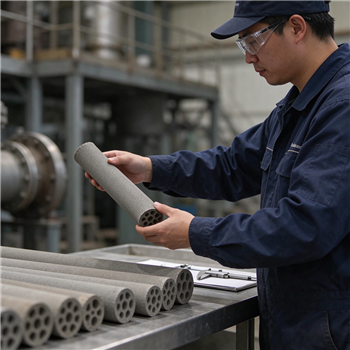
On the bench rather than in the gas stream: multi-channel SiC elements inspected before installation — where wall section, bore integrity and the accompanying test report are actually checked.
What Do Continuous 550°C and Peak 800°C Actually Mean?
Continuous rating is a material-plus-dutycycle number: the temperature the element endures indefinitely while being pulse-cleaned. Peak rating is a survival number for excursions measured in minutes. Confusing them is the root cause of most premature ceramic element failures.
The continuous rating: 550°C for homogeneous SiC
Homogeneous, recrystallized silicon carbide keeps its strength and pore structure indefinitely at 550°C because nothing in its microstructure moves at that temperature — SiC does not creep, sinter-shrink or oxidize meaningfully below ~800°C in typical flue gas. Alumina-based tubes are different: their glassy grain-boundary phases soften, so they are rated for roughly 350-400°C continuous. Cordierite and ceramic-fiber composites sit lower still. Polymer media fail above 80-130°C. The continuous rating is therefore the honest basis for every design decision.
The peak rating: 800°C, briefly and rarely
Excursion tolerance — to 800°C and, for short non-load events, toward 1000°C — exists because real plants misbehave: battery swings, burner trips, upstream upset. The rating does not license operating there. Repeated or sustained peak-temperature duty accelerates oxidation and seal aging, and the housing insulation must be designed for the peak even though the media is not operated at it.
Thermal shock: the test that separates suppliers
Temperature damage in service is rarely steady-state — it is cycling. A credible continuous vs peak temperature rating ceramic hot gas filter datasheet therefore includes thermal shock resistance test cycles ceramic filter tube data: the element is repeatedly cycled between hot gas and ambient air and qualified across 50+ cycles without cracking. Wall thickness of at least 6 mm and flexural strength above 20 MPa back this up mechanically. Ask for the test report, not the claim.
✅ Bottom line: Design to 550°C continuous, insulate for 800°C peak, and accept nothing less than documented 50-cycle thermal shock qualification.
How Do You Protect Your Temperature Rating in the Contract and in Operation?
Convert the datasheet into three contractual items — rated temperatures, test reports and operating procedures — then enforce the third one on the plant floor. Ratings fail in practice through startup ramps, not through steady service.
Step 1: Write both ratings into the specification
A proper continuous vs peak temperature rating ceramic hot gas filter specification has three lines: continuous duty (for example 400°C coke oven flue gas), maximum excursion (800°C, maximum duration), and required qualification (50+ thermal shock cycles). This single paragraph eliminates most datasheet ambiguity before the PO is issued.
Step 2: Control the ramp rates
Startup and shutdown are when elements crack. Limit heat-up and cool-down rates to the supplier's specified gradient, keep purge air flowing through the housing during shutdown, and interlock the pulse system so it does not fire cold elements. In a documented Anhui steel plant project filtering 400°C coke oven flue gas directly, disciplined ramp procedures kept the element set intact through the first year of battery swings.
Step 3: Match the supplier to the claim
Jiangsu LongMembrane High-Tech Co., Ltd. manufactures homogeneous SiC elements on a 100,000 m² production line with 100% integrity testing, and provides test reports — pore distribution, flexural strength, thermal shock cycles — with every offer, plus a 7-day sideline pilot to prove the rating on your actual gas before volume order.
✅ Bottom line: Ratings are earned by testing and kept by procedures. Specify both numbers, demand the cycle report, and control your ramps.
Frequently Asked Questions
Q: What is the maximum operating temperature silicon carbide ceramic membrane element designs can support continuously?
A: 550°C for homogeneous recrystallized SiC under continuous pulsing duty — the highest mainstream rating in industrial hot gas filtration. Anything quoted above that as "continuous" should trigger a request for the underlying test protocol.
Q: How many thermal shock cycles should a ceramic filter tube survive before I accept it?
A: Fifty-plus qualified cycles is the working standard for demanding service; fewer is acceptable only for stable, tightly controlled processes. The thermal shock resistance test cycles ceramic filter tube report should show the cycle definition (temperature delta, dwell, cooling method), not just a pass mark.
Q: My process peaks at 600°C for an hour each shift. Is SiC still suitable?
A: Yes, if excursions are bounded and documented — that is exactly what the 800°C peak rating exists for. Have the supplier model the duty cycle; LongMembrane runs this analysis as part of its free element-selection proposal, backed by case data from polysilicon, steel and fine-chemical plants.
Next Step
Send us your temperature profile — including excursions — and the LongMembrane engineering team will return a rating analysis and element proposal matched to your duty cycle. Compare our SiC membrane element specifications and the 400°C steel plant case study for verified temperature service data.
Related products
-
2 MPP trackers, Max.effciency up to 98.5%
Zero export application,VSG application
String intelligent monitoring (optional)
Wide output voltage range
Anti-PlD function (Optional) -
Albumin-bound paclitaxel takes the advantage of nanotechnology to combine the drug substance with human albumin to generate nanoparticles with improved solubility
-
1.Cylindrical magnet
2.Size:customized
3.Grade:selectable
4.Cladding:ZN/NI/NICUNI/Black epoxy -
● The cooling capacity reaches up to 3500w, providing powerful cooling performance.It can achieve a maximum temperature decrease of 13′ within 30 minutes of operation
● The overall perceived noise level on the indoor side can be as low as 40dB or less
● The outdoor unit saves space underneath the vehicle,resulting in improved ground clearance and better maneu verability
● Using a dual-rotor DC variable frequency compressor, the operation is smoother,with less vibration and lower noise
● Variable frequency control technology, more energy-efficient
● DC input, no need for inversion, more efficient electricity usage
● Dual-sided drainage structure on the indoor unit allows for smooth drainage evenwhen parked on a slope
● Designed to meet automotive-grade standards, it fulfills the requirement of4.5G vibration acceleration and can be used during both driving and parking
● The outdoor unit is waterproof up to IPX7, making it resistant to waterimmersion and washing -
Model NO:78HL4-BDV 605-625 Watt
Cell Type: N-type Mono-crystalline
Weight:34.6 kg
Transport Package:Wooden Pallet and Carton Packing
Specification:2465*1134*30mm
Trademark:Jinko solar
Origin:China


Reviews
There are no reviews yet.