

Racking for Frozen Seafood at -30°C: Galvanized Steel, Deep Lanes and 20-Year Corrosion Math
Published: November 2026, Nanjing, China — Nanjing Tianbo Storage Systems Co., Ltd. (TB), an ISO 9001-certified manufacturer with a dedicated galvanized shuttle and drive-in product line for cold
Published: November 2026 | By TB Engineering Team
Seafood cold stores are the harshest environment in the entire racking industry: −30 °C steel, salt carried in on every pallet, and humidity that swings between deep-freeze dryness and washdown fog. Systems specified for an ordinary freezer routinely rust or crack within five years here. The direct specification: the best racking for frozen seafood storage at -30°C is post-fabrication hot-dip galvanized steel on deep-lane drive-in or shuttle systems, built from low-temperature steel grades and designed around the block, not the pallet.
This guide condenses what TB (Nanjing Tianbo Storage Systems Co., Ltd.) has learned supplying factory-direct galvanized shuttle and pallet racking lines to cold-chain projects worldwide — including the 20-year seafood cold storage racking corrosion salt humid equation most suppliers never run.
1. The Best Racking for Frozen Seafood Storage at -30°C: System and Steel
The working answer to the best racking for frozen seafood storage at -30°C: hot-dip galvanized steel applied after fabrication, on drive-in or shuttle systems, with steel grades verified for −30 °C service. Three decisions sit inside that sentence, and each one has a failure story attached when it is skipped.
✅ The system decision: seafood stores on density. Frozen fish blocks are heavy (typically 1,000–1,200 kg), uniform and slow-turning — the ideal deep-lane product. Drive-in racking for fish freezer blocks is the classic answer for LIFO batch storage, packing 60–75% floor utilization with minimal steel cost per position. When the product mix includes date-coded retail cartons mixed with blocks, a galvanized shuttle system delivers true FIFO in the same deep lanes.
✅ The steel decision: ordinary structural steel loses impact toughness as temperatures fall, and −30 °C is where marginal grades start to matter. Specify fine-grained steel with Charpy impact testing at or below the service temperature — the difference is a few percent of system cost versus the risk of brittle failure under an 1,100 kg fish block.
✅ The finish decision: powder coating has no business at −30 °C — it chips on impact and rust creeps underneath. Post-fabrication HDG to EN ISO 1461, minimum 85 μm class, wraps every weld and cut edge and protects sacrificially, which is exactly the behavior salt demands.
One more zone decision completes the system: blast freezing cells. Blocks enter the chamber at −35 to −40 °C before moving to storage, and blast cells see the worst combination of frost, moisture and airflow in the plant. Keep them shuttle-served with galvanized everything, and design the transfer interface so forklifts never carry brine-coated pallets into the storage lanes. Operations that skip the interface detail spend years moving salt deeper into the store on every cycle.
✅ Bottom line: deep lanes for the block, verified steel for the temperature, galvanizing for the salt — miss any one and the other two are wasted.
2. Seafood Cold Storage Racking: The Salt and Humidity Corrosion Math for 20 Years
The seafood cold storage racking corrosion salt humid equation is decided by three local aggressors: salt aerosols drifting in from processing and thawing areas, humidity cycling at airlocks and defrost events, and washdown regimes that push brine into every joint. Zinc corrosion rates reflect that: 0.5–1.5 μm per year in coastal seafood facilities versus under 1 μm in a dry inland freezer. Run the math honestly and an 85 μm hot-dip galvanized coating carries a 20-plus-year margin even at the aggressive end — provided the coating actually covers the edges, which is why post-fabrication galvanizing beats pre-galvanized sheet (bare weld zones, ~20 μm) decisively in this industry.
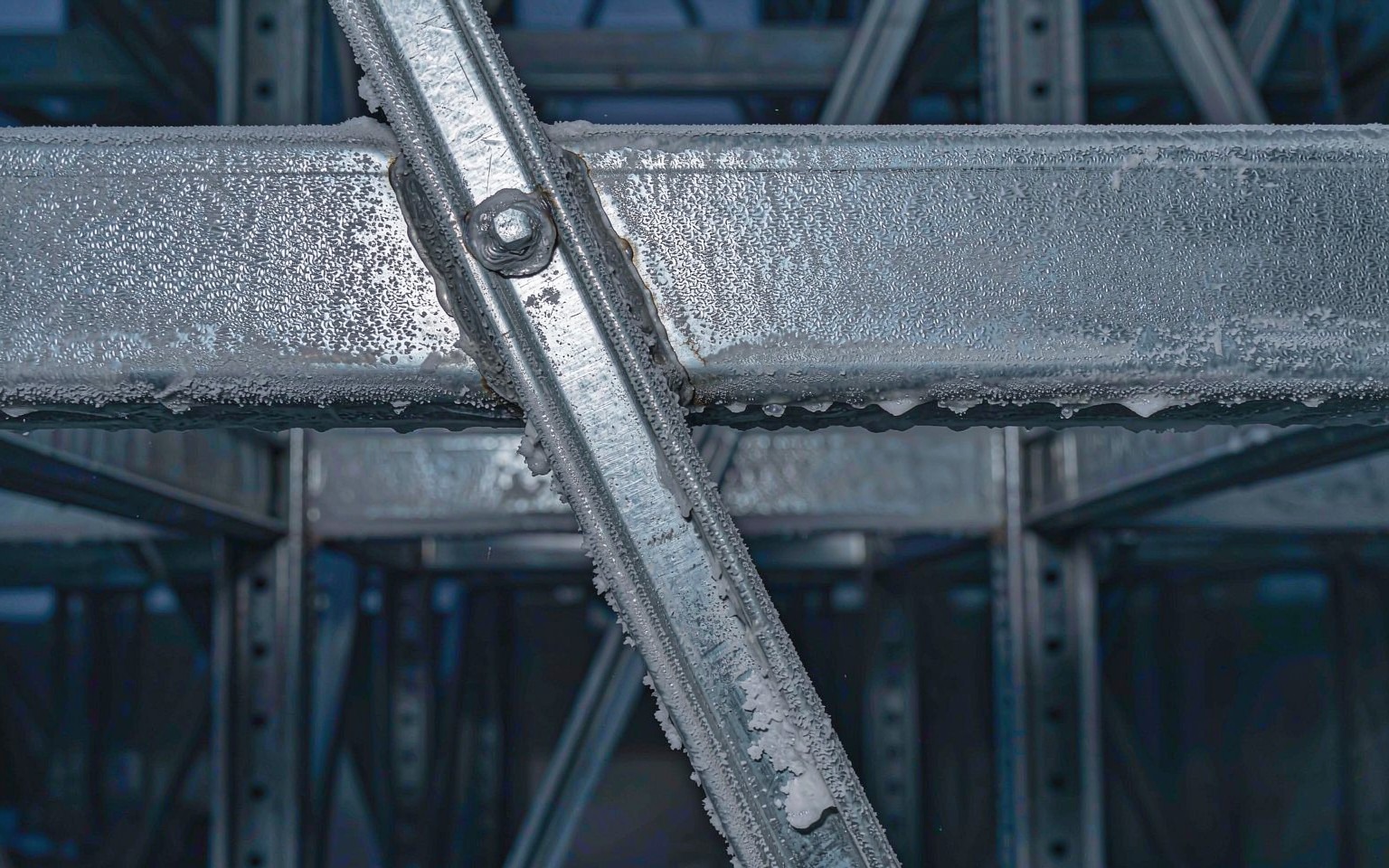
The design details matter as much as the coating: specify open profiles that drain and dry rather than closed sections that trap brine, keep galvanized surfaces from long-term contact with dissimilar metals, and detail the floor-to-column interface where defrost water and salt concentrate. Then plan the maintenance rhythm around the coating, not against it: an annual walk-through with a coating-thickness gauge on impact-prone beams, immediate cold-galvanizing spray on any exposed steel, and a five-year engineering review against the original load calculations. Facilities that run this rhythm on 85 μm galvanized systems are the same ones still passing third-party inspections at year 15 — the coating does the protecting, the rhythm does the record-keeping. TB backs its seafood specifications with measured evidence, not claims: our coating line is tested under the Chinese WB/T 1044-2012 rack standard with verified film thickness, and every OEM/ODM project ships with steel mill certificates and zinc coating reports matched to the temperature zone it will serve.
✅ Bottom line: at −30 °C with salt in the air, the seafood cold storage racking corrosion salt humid equation only closes with post-fab HDG at 85 μm class — and the documentation to prove both arrived on site.
Frequently Asked Questions
Q: Is powder-coated racking ever acceptable in a seafood cold store?
A: Only in the zones that stay above 0 °C — offices, dispatch canopies, chiller pick faces. Inside the −30 °C chamber, chipped powder plus salt equals rust within a season. The defensible rule: HDG inside the freezer, powder outside it, mixed by zone in one order.
Q: How deep should drive-in racking for fish freezer blocks go?
A: Six to ten pallets deep works for most block operations, set by your batch size and floor flatness — deep lanes amplify any floor slope across 20+ meters of travel. Confirm block dimensions (Euro 800×1,200 or industrial 1,000×1,200) early; lane geometry starts from the block, not the rack.
Q: What documentation should a -30°C seafood racking project include?
A: Four sets: steel mill certificates with Charpy results at service temperature, hot-dip galvanizing certificates with coating thickness per component batch, welding inspection records, and the design basis (EN 15512, RMI or WB/T 1044). TB supplies all four as standard with every factory-direct cold-chain OEM/ODM shipment — file them with the as-built drawings on day one, because they are the reference for every inspection that follows.
Specifying a -30°C seafood project? Send TB (Nanjing Tianbo Storage Systems Co., Ltd.) your block weights, temperatures and turnover data — our engineers will return a free galvanized system specification with zinc class matched to each zone, factory-direct from China's cold-chain racking specialists.
Related products
-
PGA fully degradable temporary plugging agent is temporary plugging agent developed mainly with degradable materials to meet the needs of oil fields under various temperatures and working conditions.
-
● Powerful units with high cooling and heating capacity
● Lightweight design, intelligent design
● Longer battery life, meeting the need for a full night’s sleep
● Energy saving/lightweight/quiet
● Split structure, bottom mounted
● Energy saving and low consumption, quality assurance
● The company has passed the automotive industry IATF16949 certification -
We adhere to the business philosophy of “gathering all the steel in the world and achieving stainless quality”, sincerely looking forward to the joining and cooperation of domestic and foreign merchants, new and old users, and working together to create brilliance
-
LED Curtain Display-P10.4, P12.5, P15.6, P25, P31.2
-
2 MPP trackers, Max.effciency up to 98.5%
Zero export application,VSG application
String intelligent monitoring (optional)
Wide output voltage range
Anti-PlD function (Optional)



Reviews
There are no reviews yet.