



How Does a Power Bank Rental System Work? A 2026 Guide
to talk about a power bank rental system working steps
Shared power bank rental systems have become a familiar sight in restaurants, airports, shopping malls, and event venues around the world. For business buyers, shopping mall operators, and distributors evaluating this business model, understanding exactly how the system works — from the moment a customer approaches a kiosk to the moment an operator checks revenue on a dashboard — is essential before making an investment decision. This article breaks down the mechanics of a power bank rental system step by step, using the operational framework of VSCHARGE (Shenzhen Welink Energy Co., Ltd.), a company with a presence in 30+ countries including the USA, Germany, Singapore, Kenya, and Japan.
What Is a Power Bank Rental System?
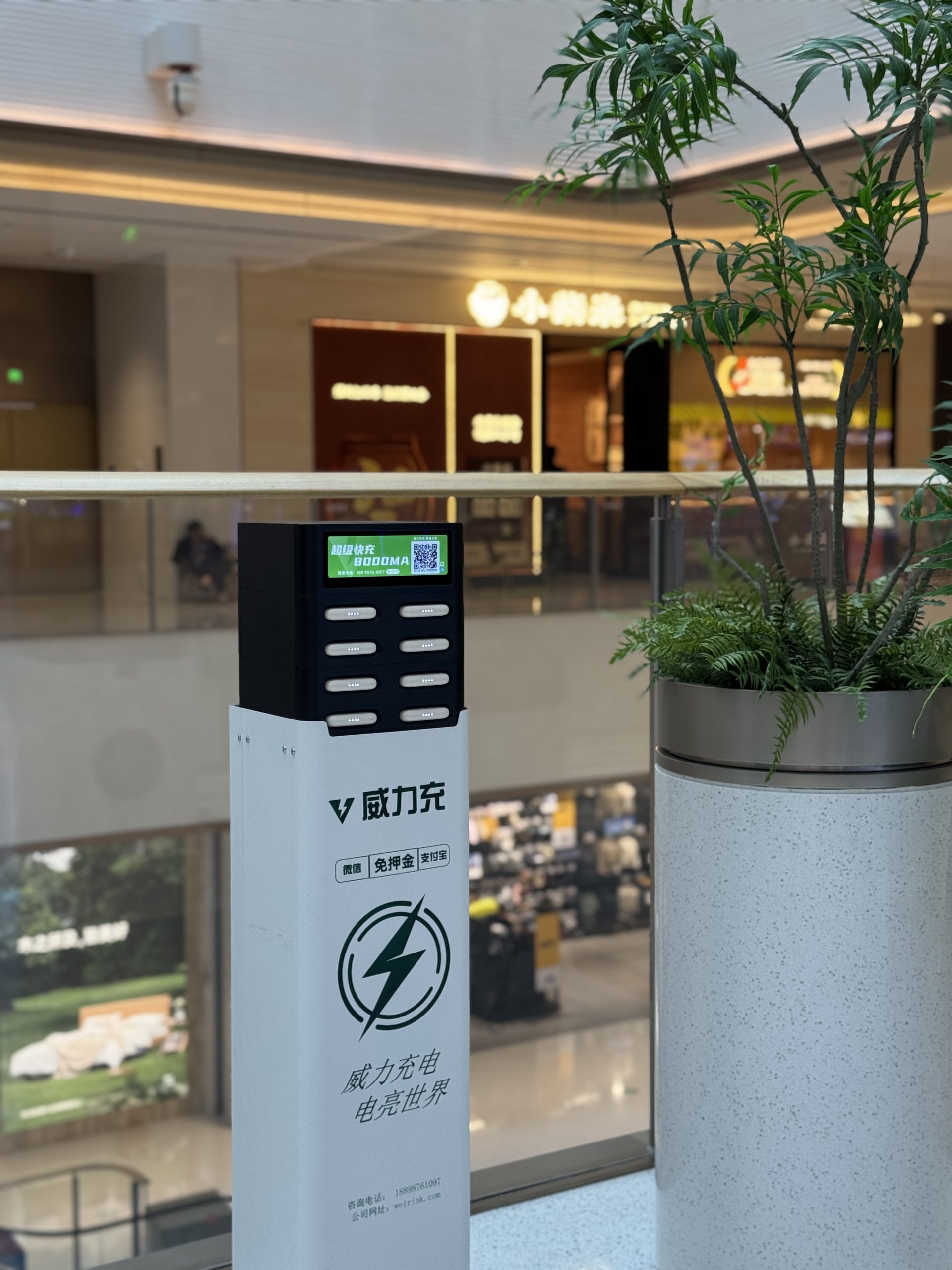
At its core, a power bank rental system is an IoT-enabled charging solution that combines four elements: a physical rental kiosk, a set of battery units stored inside it, a cloud-based management backend, and a mobile app or QR-code payment interface. Together, these components allow a customer to borrow a portable charger for a short period and return it to any compatible station once their battery need is resolved. This setup directly addresses a common pain point: end users experiencing low battery anxiety, venue owners fielding repeated customer requests for chargers, and operators managing the technical burden of IoT development, payment localization, and equipment maintenance.
The Core Components Explained
Power Bank Kiosk (Smart Rental Cabinet)
The kiosk, sometimes called a smart rental cabinet, is the visible hardware unit placed in a venue. VSCHARGE offers a range of cabinet sizes to match different venue types. The Compact Series (8/12/16 slots) is designed for smaller footprints such as cafés and restaurants, while the Advertising Series (20/24/40 slots) is built for high-traffic locations such as airports, train stations, and shopping malls, featuring 8.1" to 23.8" HD interactive screens that double as digital signage for additional monetization.
Battery Units
Inside each kiosk are the portable power banks themselves. VSCHARGE’s High-Performance Power Banks use ATL lithium polymer cells and come with integrated Type-C, Lightning, and Micro USB cables, eliminating the common problem of cable mismatch. Their housing carries a V0 flame-retardant rating, addressing device safety concerns for both operators and end users.
Cloud Management Platform
Behind every kiosk is a cloud management platform that performs real-time monitoring of device health, battery levels, revenue tracking, and remote firmware updates. This backend is what allows an operator to manage a network of stations across multiple locations without needing to physically visit each one.
Mobile App & QR Code Payment
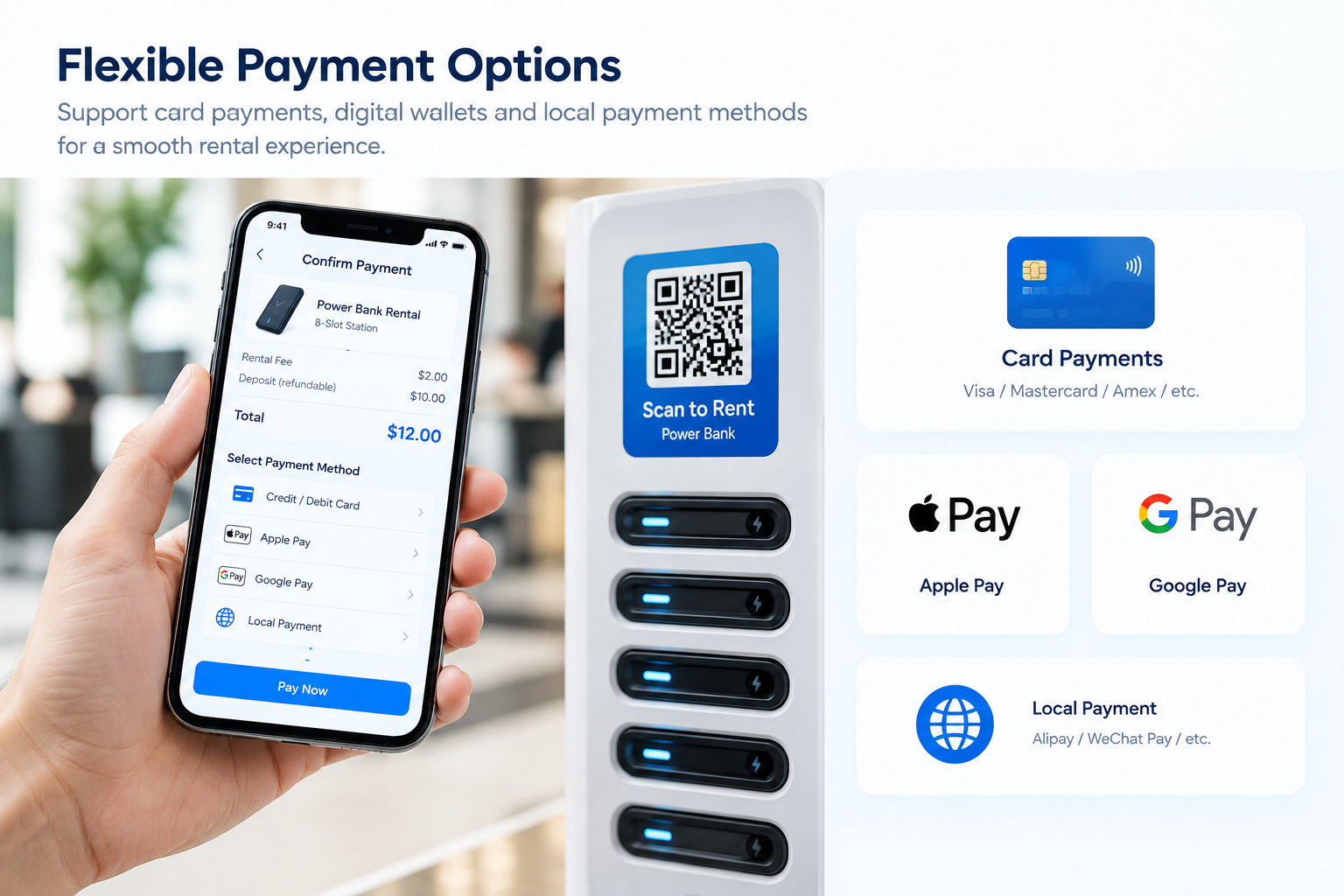
Customers interact with the system through a white-label software suite that includes customizable iOS and Android apps as well as H5 web-based rental pages. These interfaces support localized language and payment methods, including Stripe, Nayax contactless/POS, and region-specific mobile money solutions such as M-Pesa in Africa, which reduces cross-border payment friction for international deployments.
Step-by-Step Workflow of a Shared Power Bank Rental Station
The end-to-end process generally follows these steps:
- A kiosk is installed at a venue such as a restaurant, hotel, airport, or stadium, sized according to expected foot traffic.
- A customer with a low phone battery locates the kiosk on-site.
- The customer scans the QR code displayed on the kiosk using their smartphone camera or the operator’s branded app.
- The app or H5 page processes payment authorization through the supported local payment method.
- Once payment is confirmed, the kiosk automatically dispenses a power bank from an available slot.
- The customer uses the power bank to charge their device while going about their activity — dining, shopping, waiting for a flight, or attending an event.
- When finished, the customer returns the power bank to any available slot in a compatible station, not necessarily the one it was rented from.
- The system automatically calculates the rental duration and settles the final charge.
- Transaction and device data are synced to the cloud management platform in real time.
The User Experience: Rent, Use, Return
From the customer’s perspective, the process is intentionally simple: scan the QR code, rent the power bank, use it as needed, and return it to any available slot within the network. This flexibility — returning to any station rather than only the original one — is a key part of what makes shared power bank rental convenient for travelers and mobile users who may not retrace their steps.
What Merchants and Operators See on the Backend
While customers experience a simple rent-and-return process, operators and venue owners rely on the cloud management platform for day-to-day business oversight. The backend provides order tracking, so operators can see individual rental transactions; revenue tracking, which supports business decisions by showing income across stations; and device status monitoring, which covers battery levels and equipment health. Because these functions operate remotely, physical maintenance visits are reduced, and issues can often be identified before they affect customers. Remote firmware updates delivered over-the-air (OTA) further reduce the need for on-site technical intervention.
Why This Matters for Venue Owners, Distributors, and Entrepreneurs
For venue owners, deploying a rental station eliminates the burden of customers repeatedly asking for chargers and can increase dwell time and foot traffic. For operators and entrepreneurs, VSCHARGE’s model is built around turnkey economics: procurement cost reduction of 15-20%, power consumption reduction of 35%, and a failure rate below 1.5%, supported by a 99.2% product yield rate. Global compliance certifications — CE, FCC, RoHS, UL, and UN38.3 — support deployment across different regulatory environments.
Real-world deployments illustrate how the model performs in practice. In Kenya, the operator Chaaks deployed 500 units as a starting point for African expansion, focusing on localized payment support and hardware branding. In Macau, the platform Aomi integrated VSCHARGE’s system with a super-app holding 90% market share to provide charging access for residents and tourists. In Southeast Asian and European ODM projects, flexible ODM services combined with high-end advertising cabinet models allowed operators to reach break-even in 4.5 months.
Conclusion
A power bank rental system is more than a single piece of hardware — it is an integrated ecosystem of kiosks, battery units, cloud software, and payment infrastructure working together. VSCHARGE (Shenzhen Welink Energy Co., Ltd.) approaches this ecosystem through vertical manufacturing with in-house SMT and assembly, white-label software customization, and global operational support, including 24/7 assistance from dedicated international business development directors. For business buyers, mall operators, and distributors evaluating this model, understanding each component and step of the workflow — from QR code scan to backend revenue report — provides a clearer basis for assessing how such a system might fit their venue or market.
Related products
-
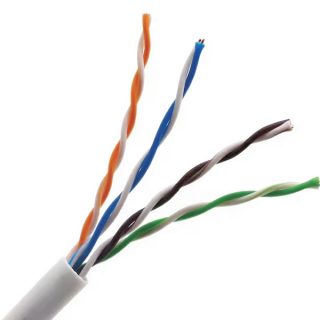
Transmission performance: 1-500MHz
Conductor: 0.56MM-0.59MM
Conductor material: Oxygen-free copper
Sheath material: PVC/LSZH/PE
Implementation Standards: YD/T 1019-2013 -
FBT splitter is an optical splitter that uses the Fused Biconical Taper (FBT) technique for splitting optical power and/or splitting wavelengths.
-
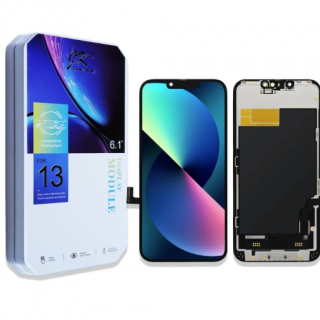
Sunlight Readability Wide Color Gamut Low Latency Energy-Saving Modes Widespread Availability
-
Transmission performance: 1-100/155MHz
Conductor: 0.445MM-0.52MM
Conductor material: Oxygen-free copper
Sheath material: PVC/LSZH/PE
Implementation Standards: YD/T 1019-2013,YD/T 1019-2023 -
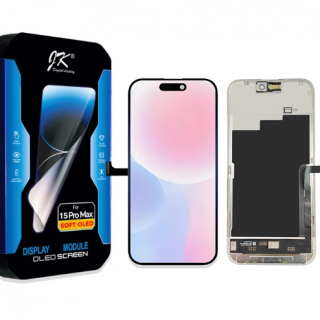
PROMOTION 120HZ SOFT OLED WATER RESISTANT NOVATEK IC DIAGNOSABLE
Reviews
There are no reviews yet.