

Top 10 Cinelifter Props for Heavy-Load Stability
Professional manufacturer of drone propellers, providing propellers for various industries including film and television drones, heavy-duty drones, and industrial drones.
1. What Are Cinelifter Propellers and Why Do They Matter for Heavy-Load Aerial Photography?
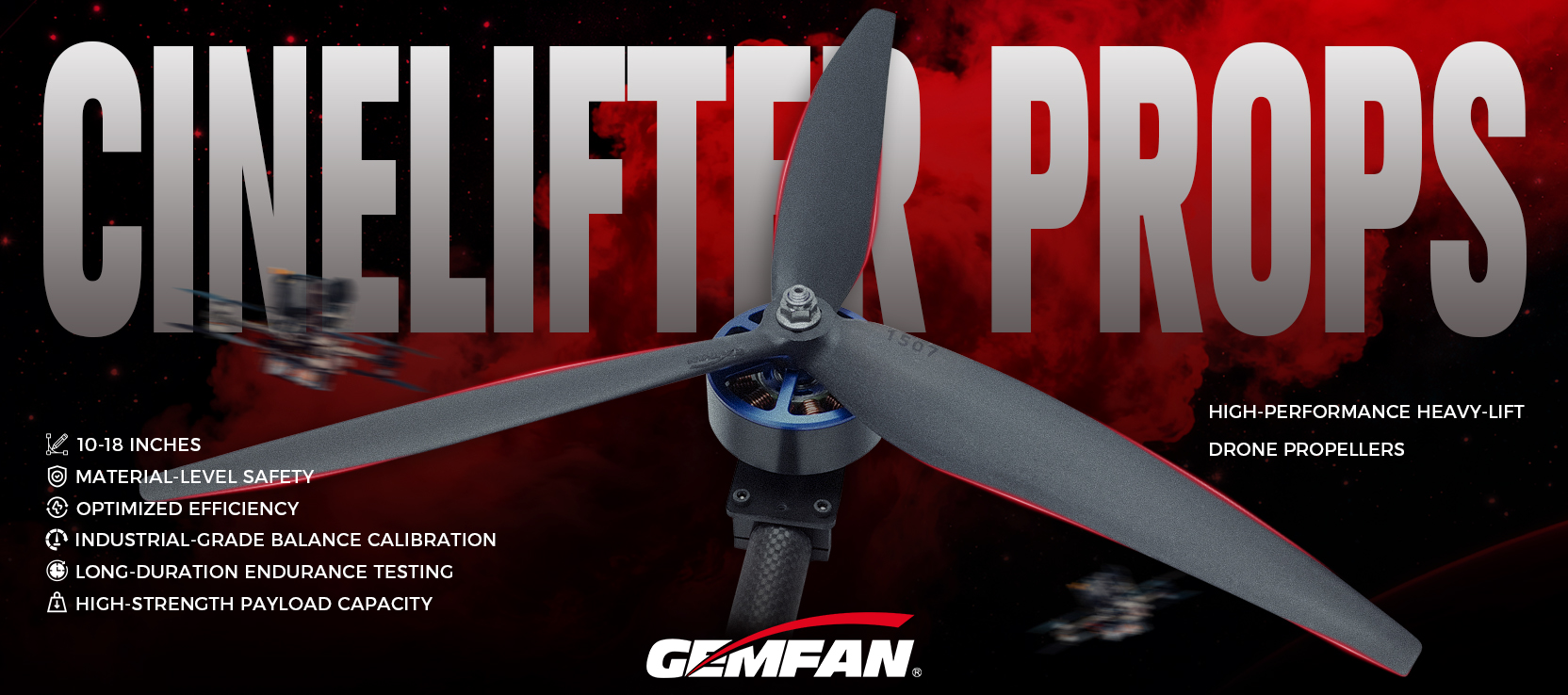
Cinelifter propellers are specialized rotor blade systems designed for multi-rotor drones carrying heavy cinema cameras and stabilization equipment in the 2-10kg payload range. Unlike recreational drone props, cinelifter props must address critical engineering challenges: eliminating high-frequency vibration that degrades image quality, preventing aeroelastic deformation under variable loads, and maintaining aerodynamic precision during dynamic maneuvers. In professional aerial cinematography and industrial inspection operations, propeller selection directly determines whether image stabilization systems can function within acceptable jitter thresholds while achieving sufficient flight endurance.
1.1 Dynamic Balance and Vibration Control
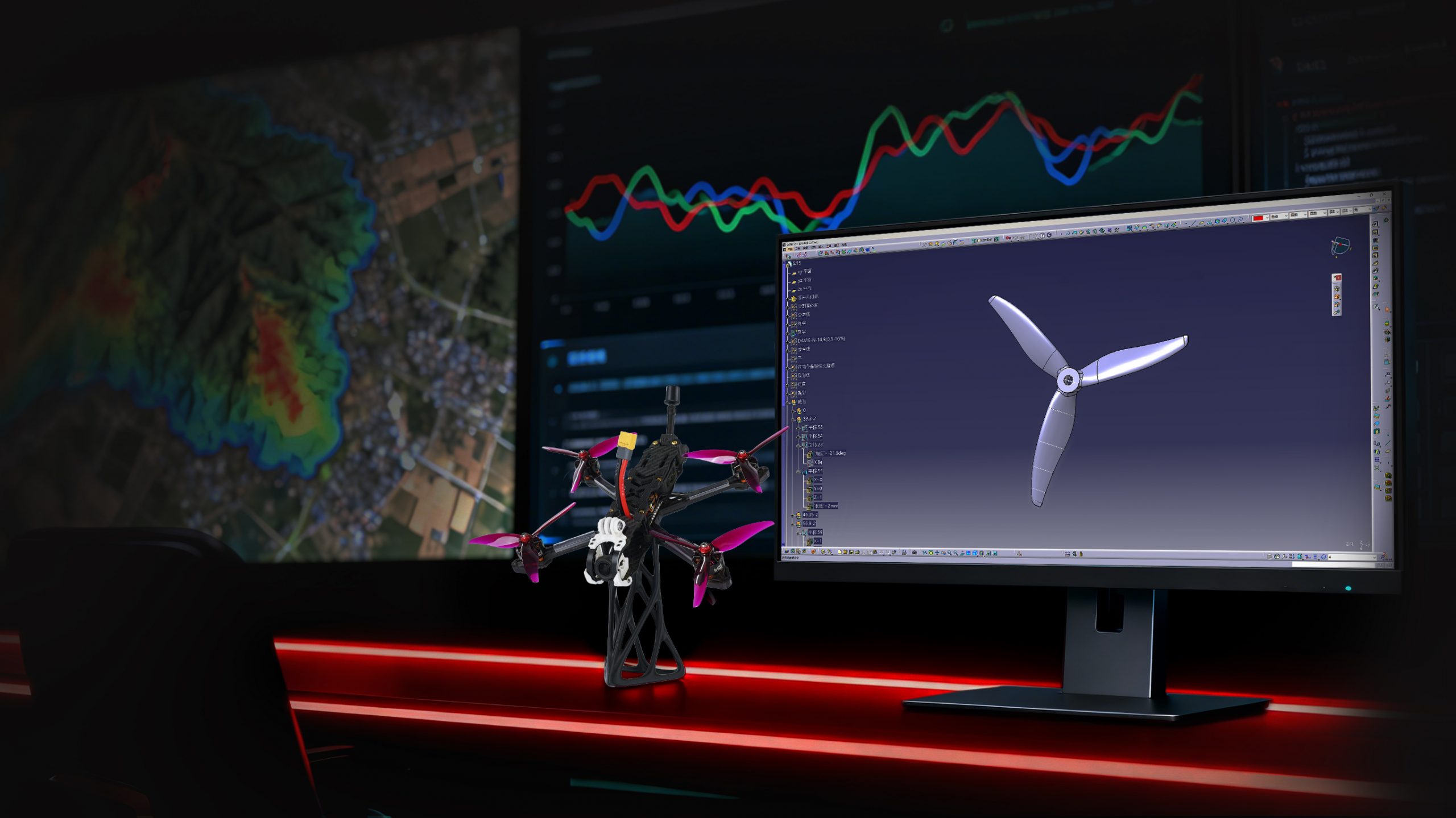
The primary technical challenge in heavy-load aerial photography involves managing resonance frequencies between the propulsion system and gimbal stabilization equipment. Professional-grade cinelifter propellers employ precision-machined interface tolerances and residual imbalance control to minimize mechanical vibration transmission to the airframe. For platforms carrying high-sensitivity photoelectric payloads, even micro-vibrations can compromise image sharpness during long-exposure captures or thermal imaging operations. Manufacturers achieve this through full-process quality control systems integrating material modification, precision molds, and dynamic balance testing protocols that verify rotational uniformity before deployment.
1.2 Structural Rigidity Under Load
Heavy-load drone operations expose propeller blades to extreme bending moments concentrated at hub attachment points and root sections. When payload mass increases from 3kg to 10kg, blade tips experience significantly higher out-of-plane bending forces that can alter the designed angle of attack distribution. Advanced cinelifter props utilize composite material reinforcement—such as carbon-infused nylon or glass fiber modification—to maintain elastic modulus integrity under stress. This structural redundancy prevents the aerodynamic twist distribution failure that causes thrust degradation and control response lag during critical filming sequences or industrial inspection maneuvers.
1.3 Aerodynamic Efficiency Optimization
The aerodynamic design of cinelifter propellers balances three competing requirements: generating sufficient thrust for heavy payloads, minimizing induced drag losses, and preserving control sensitivity. Propeller disk loading—the ratio of thrust to swept area—directly impacts hovering efficiency and flight time. Larger diameter props with optimized chord distribution and pitch settings allow motors to generate required thrust at lower RPM, reducing both energy consumption and acoustic signature. The blade solidity ratio (total blade area divided by disk area) must be carefully calibrated: excessive solidity improves thrust but degrades efficiency, while insufficient solidity compromises heavy-load lifting capability.
2. Industrial Uses of Cinelifter Propellers in Aerial Cinematography
Professional film production demands propulsion systems that enable smooth camera movements while carrying cinema-grade equipment weighing 3-8kg. The 10-11 inch propeller category serves as the primary solution for image stability in this sector, with specific designs addressing resonance elimination and dynamic filming requirements.
The 1050W 3-blade propeller represents a specialized solution for 3-6kg cinematography platforms where gimbal stabilization systems are vulnerable to power system interference. By increasing cross-sectional thickness at critical blade sections, engineers raise the bending mode frequency above the operational range of typical brushless motors (4000-8000 RPM), effectively eliminating resonance that causes image jitter. The wide-blade configuration with optimized chord distribution generates high lift coefficients at reduced rotational speeds, enabling quieter operation—a critical advantage when recording synchronized audio during aerial filming.
For dynamic shooting scenarios requiring frequent directional changes and altitude adjustments, the 1170 3-blade propeller employs a narrow-pitch geometry that prioritizes control response over maximum efficiency. This design maintains blade solidity balance to provide rapid thrust modulation while preserving adequate wing loading for environmental wind resistance. Cinematographers filming in coastal or mountainous environments benefit from the enhanced stability during sudden wind gusts without sacrificing the agility needed for tracking shots or orbital maneuvers.
2.1 Advantages in Cinematography Applications
- Jitter Elimination: Professional-grade vibration control meets broadcast quality standards for 4K-8K resolution filming
- Extended Shot Duration: Optimized energy conversion extends single-battery flight time by 15-25% compared to generic propellers
- Acoustic Reduction: Lower operational RPM decreases audible noise by 8-12 dB, enabling usable location audio recording
- Weather Resilience: Enhanced structural rigidity maintains performance in wind conditions up to 25 mph
3. Industrial Applications of Heavy-Duty Propellers in Infrastructure Inspection
Industrial inspection operations—including power line surveys, bridge assessments, and telecommunications tower maintenance—require propulsion systems capable of sustained hovering with 5-10kg sensor payloads while maintaining precise positioning accuracy. The 12-15 inch propeller range addresses these demanding operational profiles.
The 1270 3-blade propeller targets 5-9kg platforms used for extended infrastructure surveys where flight endurance directly impacts operational economics. By increasing propeller disk diameter to 12 inches, engineers reduce disk loading from typical 180 N/m² to approximately 140 N/m², significantly improving hovering efficiency. Material reinforcement at hub and root sections provides structural redundancy against bending moment concentration, preventing the cumulative fatigue damage that occurs during multi-hour inspection missions with frequent altitude adjustments.
When inspection payloads include high-resolution LiDAR or multispectral imaging systems weighing 7-10kg, the 1410 3-blade propeller becomes essential. This design emphasizes out-of-plane bending stiffness to maintain aerodynamic geometry during heavy-load maneuvers such as close-proximity wall scanning or emergency descent procedures. Optimized for 1000mm wheelbase platforms, it balances endurance efficiency with the strict jitter control requirements of precision measurement instruments that have angular resolution specifications measured in milliradians.
3.1 Advantages in Infrastructure Inspection
- Mission Duration: Increased efficiency extends inspection flight time to 35-45 minutes with standard battery configurations
- Payload Flexibility: Structural capacity supports simultaneous mounting of multiple sensor types (thermal + RGB + LiDAR)
- Positioning Precision: Reduced micro-vibrations enable millimeter-level accuracy for 3D structural modeling applications
- Safety Margins: Enhanced blade stiffness prevents performance degradation during emergency maneuvers near obstacles
4. Applications of Precision Propellers in Agricultural Drone Operations
Agricultural drones conducting crop monitoring, precision spraying, or livestock surveillance require propulsion systems that accommodate variable payload masses while maintaining operational reliability across diverse environmental conditions. The mid-range 8-10 inch propeller category serves this sector’s unique cost-performance requirements.
The 8046 3-blade propeller addresses the power response challenges in 2-4kg agricultural platforms that alternate between survey missions (minimal payload) and targeted intervention tasks (chemical/seed dispensers). The enhanced torque resistance achieved through glass fiber nylon modification enables rapid acceleration during field-edge turns without blade flutter, improving operational efficiency in row-crop environments where frequent directional changes are necessary.
For larger agricultural operations deploying 4-6kg platforms with multi-spectral cameras and RTK positioning systems, the 9045 3-blade propeller provides cruise efficiency optimization. The 4.5-inch pitch setting maintains induced losses at minimal levels during sustained forward flight at 8-12 m/s—the optimal speed for NDVI imaging and photogrammetry data collection. Precision-machined interfaces reduce vibration transmission that would otherwise compromise the geometric accuracy of orthomosaic maps generated from aerial imagery.
4.1 Advantages in Agricultural Applications
- Operational Economics: Improved efficiency reduces cost-per-hectare for crop monitoring services by 20-30%
- Data Quality: Vibration reduction enables use of higher-resolution sensors without expensive isolation mounts
- Field Coverage: Extended endurance increases single-flight coverage from 15 to 22 hectares in typical survey missions
- Equipment Longevity: Reduced mechanical stress extends motor bearing life and decreases maintenance intervals
5. Specialized Applications in Public Safety and Emergency Response
Emergency response drones supporting search-and-rescue operations, disaster assessment, or law enforcement surveillance require propulsion systems that prioritize reliability and performance consistency across extreme operational conditions. The flagship heavy-load category addresses these mission-critical requirements.
The 1507 3-blade propeller represents the premium solution for platforms carrying high-sensitivity thermal imaging and long-range optical systems weighing 8-12kg. Public safety applications demand extremely low residual imbalance because target detection algorithms rely on image stability measured in fractions of a pixel. The 15-inch diameter combined with 7-inch pitch provides the thrust characteristics necessary for heavy-load takeoff while maintaining cruise efficiency during area search patterns that may extend 45-60 minutes.
Emergency response scenarios often require rapid deployment in suboptimal weather conditions where wind shear and turbulence challenge flight stability. The 1310 3-blade propeller with carbon nylon construction provides the high composite material elastic modulus necessary to maintain preset aerodynamic layout integrity during dynamic flight through variable wind fields. This capability proves critical when conducting night search operations or post-disaster structural assessments where environmental conditions are unpredictable.
5.1 Advantages in Emergency Response Operations
- Mission Reliability: Enhanced structural integrity reduces in-flight failures during critical search-and-rescue operations
- Environmental Adaptability: Maintains performance across temperature ranges from -10°C to 45°C
- Detection Capability: Micro-vibration control enables thermal imaging resolution sufficient for human detection at 500+ meter ranges
- Rapid Deployment: Consistent performance characteristics reduce pre-flight calibration time during emergency mobilization
6. Key Selection Criteria for Cinelifter Propellers
Selecting optimal cinelifter propellers requires systematic evaluation across multiple technical dimensions. Payload-to-thrust ratio should maintain margins of 1.8:1 to 2.2:1 for adequate control authority during dynamic maneuvers while preserving energy efficiency. Vibration specifications must align with gimbal stabilization system sensitivity—broadcast cinematography typically requires residual imbalance below 0.5 gram-millimeters, while general industrial inspection may tolerate 1.5 gram-millimeters.
Material selection directly impacts operational longevity and performance consistency. Glass fiber-reinforced nylon offers excellent cost-performance for platforms under 6kg, while carbon-nylon composites become necessary for heavy-load applications above 8kg where aeroelastic deformation must be minimized. Diameter and pitch combinations should be matched to motor KV ratings and battery cell configurations—higher diameter/lower pitch favors efficiency and endurance, while smaller diameter/higher pitch prioritizes thrust and control response.
Environmental operational requirements influence material durability specifications. Agricultural and maritime applications demand UV-resistant formulations and enhanced impact tolerance, while indoor inspection platforms may prioritize noise reduction over environmental resistance. Professional operators should verify that propeller manufacturers provide comprehensive thrust-power-efficiency data curves across the operational RPM range to enable precise mission planning and flight controller tuning.
Companies like Gemfan Hobby Co., Ltd. exemplify manufacturers that address these multifaceted requirements through integrated engineering approaches. With nearly twenty years specializing in propeller research and manufacturing, such firms develop proprietary material modification processes and precision molding techniques that deliver gradient coverage from cinematography-grade to industrial-grade solutions across the 8-15 inch spectrum. Their systematic approach to quality control—encompassing material modification, precision molds, and dynamic balance testing—ensures consistent performance characteristics that enable professional operators to achieve demanding mission objectives across cinematography, infrastructure inspection, agricultural monitoring, and emergency response applications.
Related products
-
Deep groove bearings are a widely used bearing type known for their simple design and excellent performance.
-
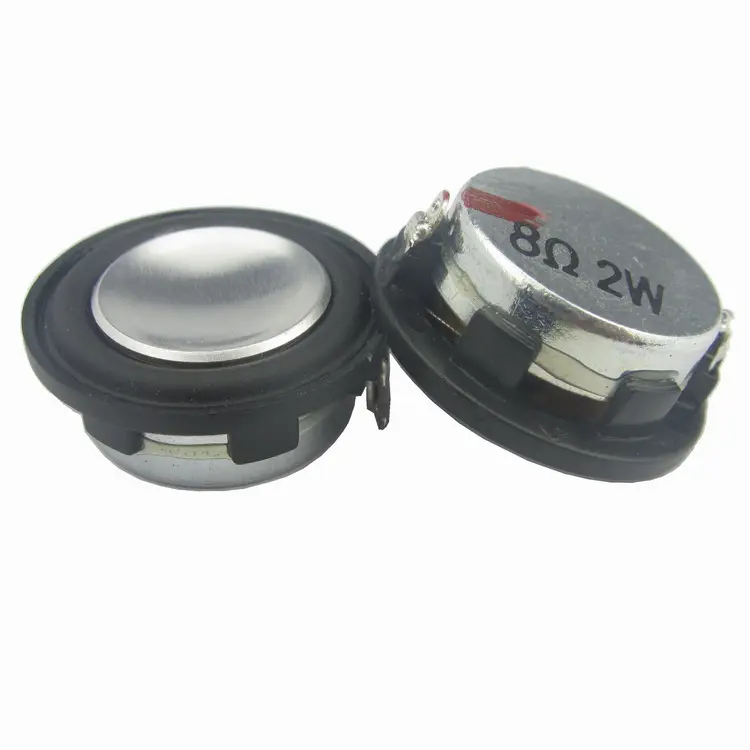
Compact 28mm Horn Driver – 2W, 4Ω/8Ω, for Mini Audio & Alert Systems
1.1 Inch Mini 2W Full-Range Horn Speaker (4Ω/8Ω, 28mm) -
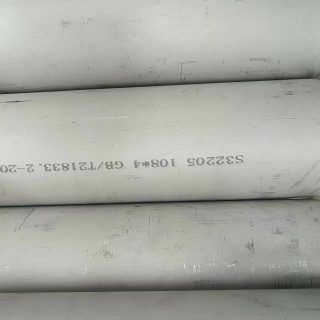
Specification: ASTM A790/A790M
Name: Duplex SS S32205 Seamless Pipe
Grade:S32205
Process: Seamless
Delivery Condiction:
1. Annealed, Pickled
2. Bright Annealed -
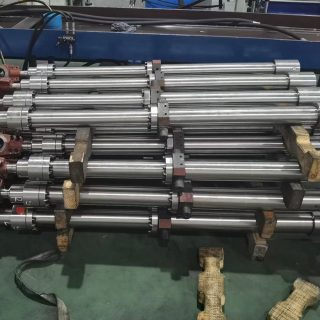
Wuxi Aojin Hydraulic Machinery Co., Ltd. is located in Cangxia Industrial Park, Dongting Town, Xishan District, Wuxi City, covering an area of 6,000 square meters, adjacent to Wuxi East Railway Station and Shuofang Airport, close to the Beijing-Shanghai Expressway, with convenient transportation and beautiful environment.
-
Used for moving small part of machine with high speed.
Reviews
There are no reviews yet.